

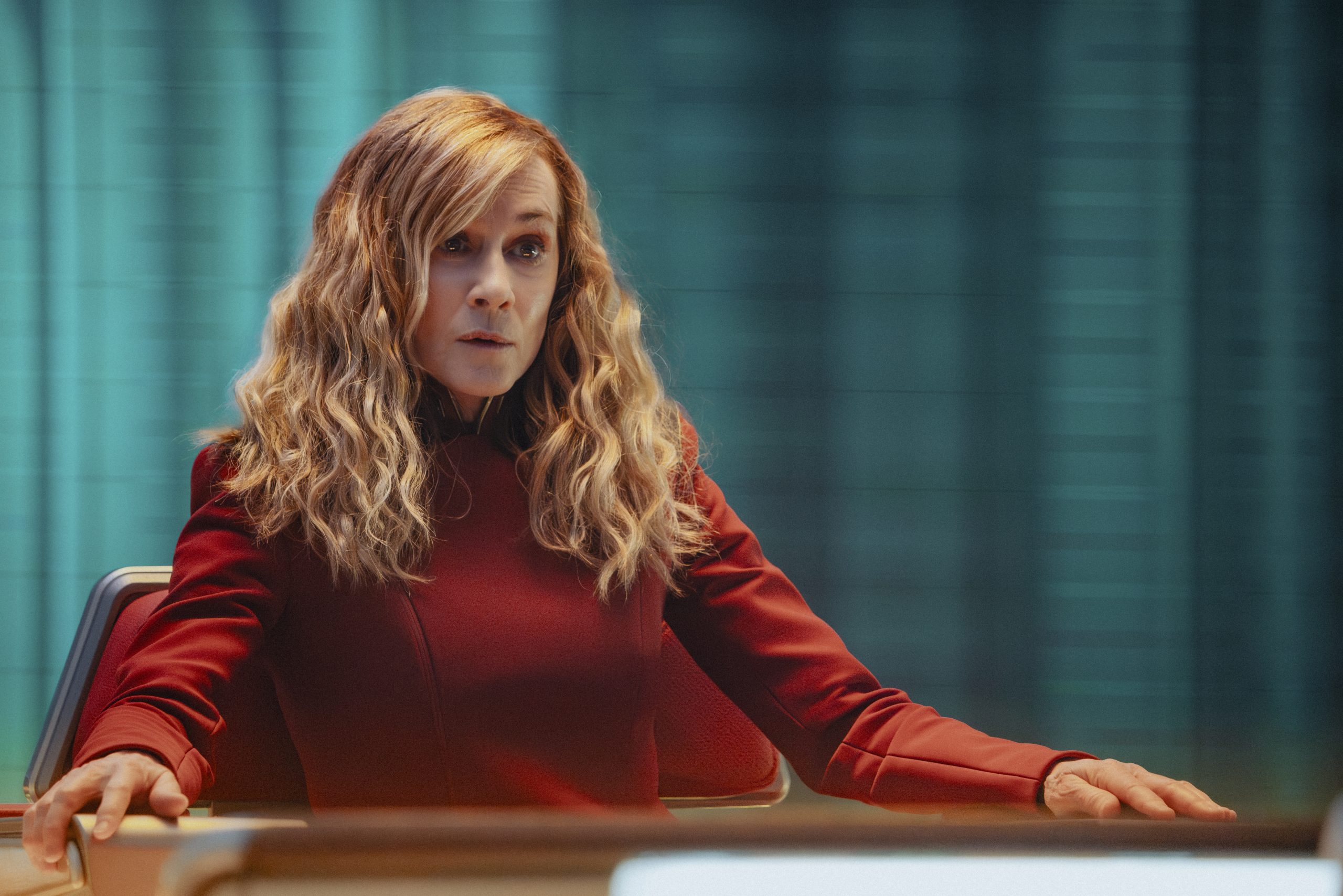

The Federation has been completely walled off from the rest of the quadrant as it stands trial for crimes against the galaxy, while the USS Athena is crewed by only a few officers and a bunch of first-year cadets. Star Trek: Starfleet Academy ends season one with a bang.
Considering the size of space, the premise of placing mines along the entire perimeter of Federation space to isolate it is a goofy premise, though far from the goofiest this franchise has delivered.
Once I overcame my suspension of disbelief concerning this element of “Rubincon” I was delighted the episode put the Federation itself on trial. Given its “post-Burn” setting and emphasis on a brand new generation bringing a new perspective, Starfleet Academy is perhaps best suited of all the Trek spinoffs to really reckon with the Federation as a flawed institution.
It’s even already laid that groundwork with Caleb’s backstory as well as the grievances explored earlier in the season with both the Betazoids and Klingons. So when Nus Braka opens the trial by saying he’s “speaking to the desperate, the ignored, the left behind,” this is not coming out of nowhere. We’ve already seen examples of how the Federation failed both its member worlds and individual citizens like Caleb Mir.
I was never crazy about the Caleb searching for his mother storyline, but the writers managed to make it work when this macro trial of the Federation is pared down to the personal trial between Nahla Ake and Anisha Mir serving as proxies for the grander debate over the Federation’s soul. I said of last week’s episode that it underused Tatiana Maslany. That’s not the case in “Rubincon.” Maslany is terrific here as Anisha and is allowed to take center stage when Braka declares “She alone will decide if the Federation deserves a reprieve or a more final penalty.”
As I discussed in my review of last season’s Star Trek: Strange New Worlds episode “What is Starfleet?” I was let down by that story, which started with the tantalizing concept of asking us to reckon with the ethics of Starfleet’s military arm only to fail due to the writers’ lack of nerve. But unlike Strange New Worlds, writers Alex Kurtzman and Kirsten Beyer don’t pull their punches here. Anisha grills Ake on the institutional harms of the Federation and Ake’s own complicity in them.

Photo: John Medland/Paramount+
My favorite confrontation begins with Anisha saying Braka was the only one who risked anything for her. “What does the Federation risk?” she asks. She, like so many others on the fringes, was failed by the Federation’s false promises. Anisha continues with an attack on Ake’s “little show of resigning,” mocking the “this isn’t what I signed up for” excuse. When Anisha says Ake only resigned after following orders that violated her principles, not before, it’s a devastating point.
Ake asks Anisha what she wants. “I want you to have no shelter from this. I want you to feel it every day,” Anisha responds. Anisha can’t get back the time with her son that Ake and the Federation took from them. Real accountability is the only achievable justice she thinks she has left, the guilty not being protected from facing consequences for the injustices they’ve committed.
Not being able to just move on. It’s a simple plea that lands a knockout blow. And one that likely resonates with the helplessness many in the audience must feel today as powerful figures in our present world are being allowed to skirt legal prosecution despite ubiquitous evidence of institutional corruption and abuse.
As I wrote in my review of “Vox in Excelso,” I love Star Trek courtroom dramas. Many of my all-time favorite Trek episodes involve some trial conceit: “A Measure of a Man,” “The Drumhead,” “Ad Astra per Aspera.” Indeed, I hold Star Trek: The Next Generation‘s series finale “All Good Things” in particular high regard because of the deft manner in which its writers Ronald D. Moore and Brannon Braga managed to reframe the entire series as humanity on trial.
In the end of that story, Q tells Captain Jean Luc Picard humanity’s trial is never concluded but that we’ve at least shown the potential to expand our thinking to consider new possibilities. This sort of examination of the human condition while challenging us to strive towards our better selves is what I come to Star Trek for in the first place. So when Nus Braka revealed he’s putting the Federation on trial, I was thrilled.
A criticism frequently leveled at the Marvel Cinematic Universe (MCU) relates to how they often so legitimize their villains’ judgment of the status quo that the writers feel they must then turn the villain into too violent a fanatic for their cause or flawed in some otherwise essential way. By making the villain a bad messenger for their righteous cause, the heroes’ remain “the good guys” in defeating them. This can create the unintended consequence of making the heroes’ victory feel like a mere restoration of the very unfair status quo the villain correctly challenged.
That brings us to Nus Braka, because “Rubincon” dances on the edge of making a similar mistake. Paul Giamatti’s big performance was my least favorite part of the series’ pilot. Braka then began to grow on me in “Come, Let’s Away” by demonstrating he’s a more calculating and formidable opponent than he previous appeared.
I said in that review what I needed from Braka to make him a more iconic Trek villain was a more compelling motivation, backstory, and underlying philosphy. The writers deliver exactly what I asked for here. I just wish the episode had opened with a flashback where we got to see Braka’s defining childhood trauma for which he blames the Federation instead of that information only being told to us.
But my biggest criticism comes once Caleb’s chemistry knowledge proves Braka was wrong to blame the Federation for his colony’s tragic end. Braka calls it all propaganda and even tries to detonate the Omega-47 bombs. I’m okay with Braka not being able to immediately accept his whole worldview has been a lie and lashing out in desperation.
Ake asks Braka’s marginalized allies, “Is this the person you want to follow into the future, an angry child with his finger on the trigger, whose entire worldview is based on a lie?“ It’s a wonderfully pointed line that seems to be addressing millions of Americans in 2026. If only those in 2026 were so easily convinced to abandon angry children with fingers on the button…
But, like with the MCU, once Braka has been exposed as a fanatic the central debate over the Federation’s failures is sidelined. Perhaps a line or two at the end suggesting the Federation going forward would be taking actual steps creating an independent body of non-aligned worlds to adjudicate cases of grievances against the Federation would suggest more self-reflection and evidence of systemic change, that a lesson had been learned.
I recognize this review of Starfleet Academy is light on discussion of its actual primary cadet characters. The cadets are given plenty to do but unfortunately are saddled with the less provocative storyline. It’s great seeing every cadet slip into their natural roles on the Athena as they do all the very plotty stuff to safely disarm the Omega-47 mines. I just wish that part of the episode could have been more quickly resolved allowing them each their own individual, character-appropriate moments to participate in the juicier trial story instead.
For better or worse, modern Trek is obsessed with these grand, high-stakes galactic threats. I’d prefer the franchise wasn’t so insecure as to believe it needs such gimmicks to keep the audience, but if they’re going to be at least limited to the season finales, I can live with it.
This season of Starfleet Academy has otherwise almost certainly maintained the longest stretch of low-stakes stories I can recall in the franchise’s history, so maybe it earned its big, galactic-sized peril finale. And the premise of a wall imposing isolation on the Federation by trapping them within is intriguing when considered next to Donald Trump’s infamous pitch to a pro-isolationist America to build a wall to keep others out.
“Rubincon” is not the greatest showcase for its young, main cast of cadets but it’s good Star Trek because of its fierce interrogation of the institutional failings of the franchise’s central organization. If Nus Braka had been Ake’s lone adversary in the trial, the undermining of his perspective might have fatally undermined the entire enterprise as we saw in Strange New Worlds‘ “What Is Starfleet?” Fortunately, the writers wisely let Anisha Mir step into the prosecution role, legitimizing the charges.
Nevertheless, I wish the episode’s ending provided concrete policy changes opening the door to a redress of grievances by those the Federation had failed, but narratives challenging the harms caused by systems instead of merely individuals are sorely needed, particularly the naive notion presented in “What Is Starfleet?” that institutions are good if they’re staffed by good individuals. It’s about time a franchise boldly went where none have gone before and sincerely challenged its own heroes’ organization proclaiming, like Admiral Christopher Pike did in the 2009 film Star Trek, “I dare you to do better.”
Watch Star Trek: Starfleet Academy on Paramount+.




You must be logged in to post a comment.