



“Nothing like betrayal and a new super power to open a guy’s eyes.”
A year and a half into its run, Justice League Unlimited has been a bumpy road. It’s been mostly cruising, but a few glaring potholes have been found along the way. Mark Waid’s extensive career and knowledge of canon makes for consistently enjoyable takes on niche characters. While longtime creators may understand the ins and outs of their craft, even they can fall through the cracks occasionally, and comics, like any medium, are doomed to repetition.

The last issue of the League’s adventures dealt with some of the fallout from the Omega Tournament. Participants in the tournament received prophetic visions of a dark future, and could only spend their victory dwelling on what to do in preparation for the next fight. Meanwhile, villains of the world have a bone to pick with them for having been sidelined while the world was ending. But since the world didn’t end, where do we go from there, you ask?
That’s right, we put villains on the Justice League again.

DC
The main focus on this issue is fleshing out the concept of a villain amnesty program, in which the League recruits villains into its ranks to unite all metahumans against yet another looming universal threat teased in DC K.O. Remember what we said about art and repetition?
Joking aside, there is still some interesting stuff happening, as conditional redemption on such a scale is actually a unique take on the idea. A very dramatic opening featuring Wonder Woman, Batman, and Captain Ma—I mean, Shazam™ very strikingly illustrates the desperate nature of such a plan, and that it must remain a secret until they know it works. This is followed through at first with a sweet scene of Plastic Man making a fitting case to younger heroes about redemption. After that, Lex Luthor and Giganta deal with business-as-usual grunts in the country of Bialya under the supervision of WildCat and Connor Hawke. It’s a very entertaining bout that leads to a very effective last page stinger, but we can’t help but think that it was somewhat hindered by the presence of less prudent plotlines.
Now, when the main selling point of your series is to be the flagship title of a universe, that comes with high potential and stakes, but also a lot of caveats. One such caveat is balancing the main plot with planting seeds for the wider narrative, the latter of which the book spends a lot of time on, which leads to a lot of exposition that doesn’t always apply to its own central narrative. Waid is typically a master at this aspect, and the issue did absolutely feel refocused on those character driven strengths, but only to a point.
Here, Waid taps into the comedy of Justice League International instead of the usual character-packed, high-octane action homage to the JLA of the 1990s, even going as far as putting a lot of those characters in the spotlight. Much of the issue follows Ted Kord wandering the Watchtower to figure out what everyone is doing—and most importantly, to take jabs at Guy Gardner and his aspirations of space pseudo-catholicism. It’s an effective method to deliver exposition, and a much less intrusive way to set up spinoff books. Alas, it is still much more exposition heavy than a book like this should be. JLI and JLA nostalgia is nice, but this far in the run it almost feels like the series doesn’t quite know its own identity beyond its purpose.

DC
On the art side, Clayton Henry is fantastic. He utilizes more traditional paneling to put a heavy emphasis on Waid’s more dramatic scenes such as the aforementioned opening. Henry is given much more to chew on with this installment as we see some fun action heavy scenes and some brilliant slice of life/worldbuilding moments with Ted Kord and the remaining Watchtower heroes. Henry uses the more comedic scenes, like between Ted and Guy, to showcase his ability to create a more down to earth environment. Which, as shocking as it may be, is actually a bit hard to achieve sometimes.
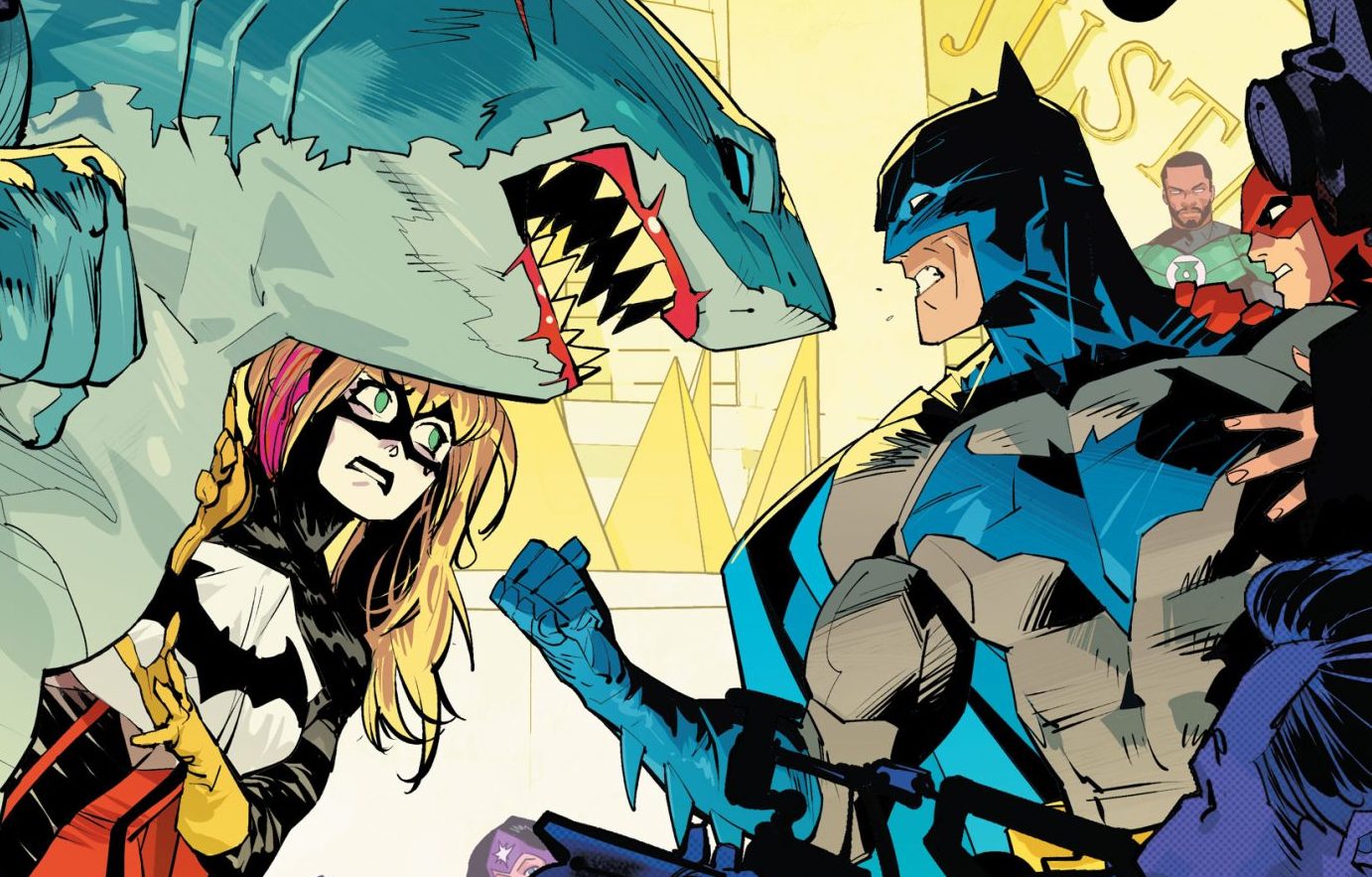
Now, what hinders Henry’s art here is actually a small problem with Ariana Maher’s lettering, or more accurately with the excessive use of character name tags. Part of the problem could fall onto Waid himself as writer, but it feels like some emotion or emphasis is lost with the inclusion of half a dozen a dozen name captions. The opening sequence with the Trinity, as mentioned before, is a great sequence from Henry, but we don’t want to see Batman’s name under a very obvious drawing of Batman. We can understand having them for the sake of such a large rotating cast and for new readers, but for certain characters we should be long past this.
Justice League Unlimited #18 is not a perfect issue, but it effectively refocuses on the strengths of its creators and pulls together its own engaging narrative devoid of pesky crossovers. It still falls into some traps from previous issues, such as getting distracted from its own story, but the slice of life approach to displaying such plot points is a huge improvement over things simply just being said into a vacuum to advance unrelated plots. But boy does it make us miss Justice League International.




You must be logged in to post a comment.