

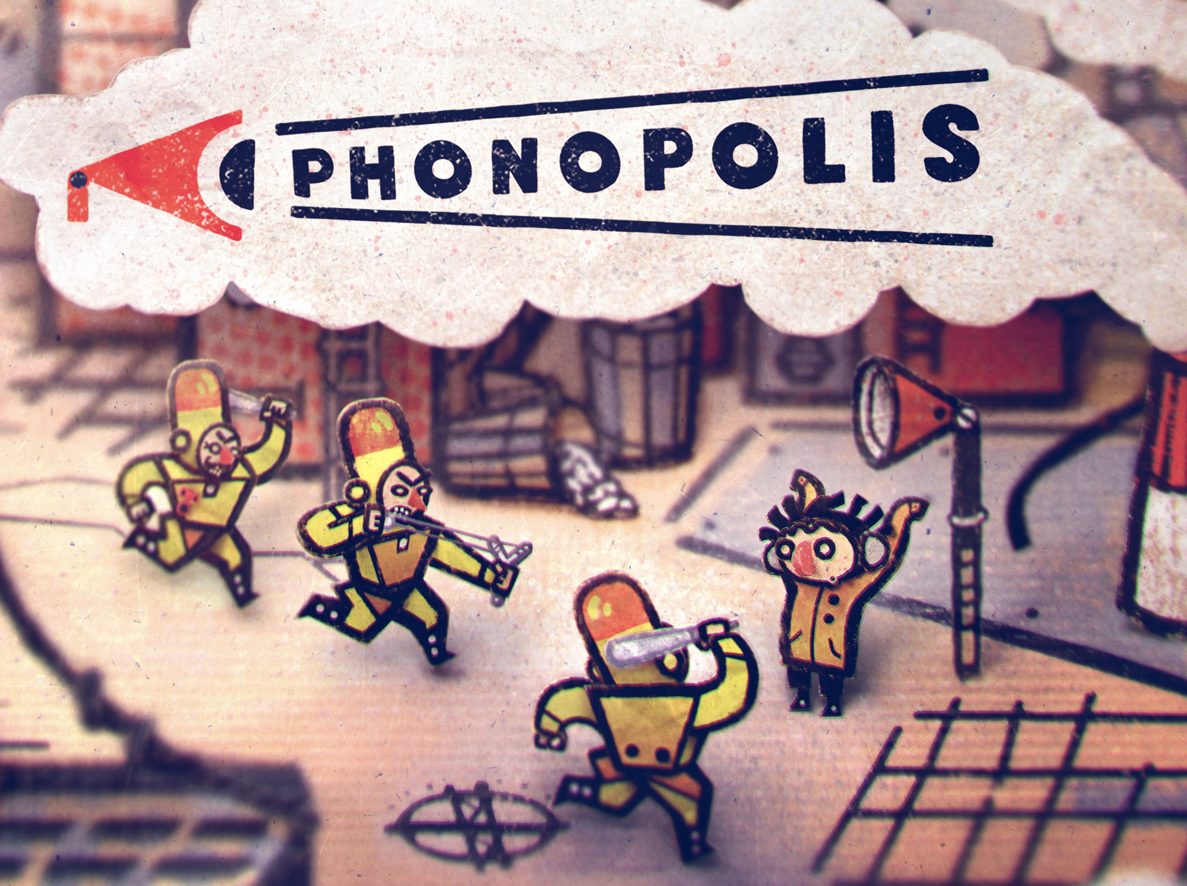

Phonopolis, from Amanita Design, is a point-and-click adventure game similar to their previous games, Machinarium, Botanicula, and Samorost. Phonopolis is a huge undertaking for Amanita Design, moving them into 3D graphics and adopting an extremely distinctive art style inspired by the ‘propaganda’ artistic trends, such as constructivism and futurism.

I can’t eloquently speak to music, though I will try my best to speak to the brilliance that is the music and audio design of Phonopolis. There was a complexity and nuance to the music, but it was still inviting and simple. An assortment of instruments and melodic structures is present throughout the entire game, and even shifting within singular scenes. Rhythmic drums subtly turn into a groundswell of victory trumpets, or different instruments are layered into a scene’s solution, which are so impressive that even the ‘wrong’ musical combinations sound pleasant. Phonopolis is the only media, aside from the movie Whiplash, that gave me a similar visceral emotional feeling of experiencing live music.
Phonopolis is an adventure puzzle game. Both of those genres are bigger and more sub-genred in modern times, and the best comparison point is the Lucas Arts adventure games like Grim Fandango and Escape from Monkey Island. You move from heavily curated scene to heavily curated scene, solving puzzles by either interacting with the world through buttons and NPC triggers or a consistent ‘brick breaker’ game that shows up multiple times.
The scenes are where Phonopolis shines. Each new scene was unique and took multiple steps of Rube Goldberg-esque momentum to complete. They contained an impressive amount of different mechanics and physics, where it was exhausting to do a long playthrough because each scene required a complete mental reset.
The ‘brick breaker’ mini-game was fun and became surprisingly very complex by the end, without introducing too many variables. The puzzles were difficult, but fair. Some of them I ended up brute forcing my way through or accidentally solving, but many of them remained memorable and were a great time dissecting. Not to reveal too much, but there was a scene built around making food that was an absolute delight and my personal favorite.

The story is simple. Felix, our main character, falls into a hole and finds the art of the old world. He is also given headphones that drown out the Leader’s speakers, which command the population into doing mindless tasks. Felix is given the job of finding the key to stop the Leader from performing the final loud proclamation known as the Absolute Tome.
Felix is not a revolutionary, nor is he going to provide a riveting speech. He is just a man who found a way to block out the world’s noise and enjoys it. The ‘everyman’ aspect to the story, and the various characters he met along the way, was a nice change of pace from overserious single-player games. The main cast is small, but personality oozes from the one-off NPCs who inhabit the world. The themes and the nonchalance of Phonopolis made for a cozy, uplifting experience.
A labor of love, visually as much as sonically. Aminata Design did the painstaking process of digitizing cardboard textures to insert into the game world. They even have the footage baked within the game in a ‘making-of’ feature to prove it. A gorgeous and confident, fully-realized world they created that will be on many ‘best-of’ short lists at the end of the year. For them to use these various avant-garde art styles and still inject a ton of color and personality into the world is a huge feat. Each scene was so expertly handcrafted and had so much detail that you almost didn’t want to leave and move on.

The ‘bang for your buck’ crowd will have valid concerns with Phonopolis. The time it took to complete the game was a hair under five hours. I didn’t achievement hunt and stuck to the main path, but I can’t imagine getting more than another hour or two from the game. With replayability, unless you want to experience the world again, not much else is available. The puzzles are so interwoven into the scenes that the game only functions at one speed and difficulty. Phonopolis is such a curated experience, but I would have loved to have had a reason to stay in their world for a little while longer.
Phonopolis is why we need art and artists from different disciplines to collaborate. As a form of artistic expression, Phonopolis is a near-classic. Still, the niche gameplay and short length with limited replayability may hinder your enjoyment if you are only looking for a straight video-game experience.




You must be logged in to post a comment.