


Some fantasy worlds feel designed — others feel practically discovered.
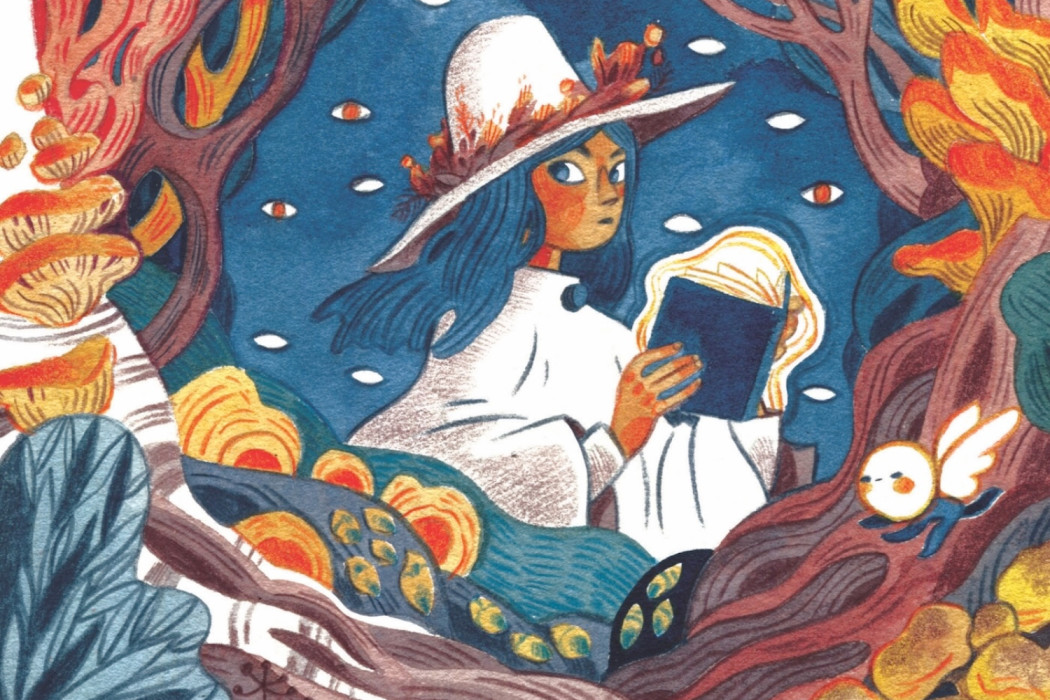
Reading Candice Purwin’s new graphic novel The Book of Murmurs, it is easy to believe the world of The Fault existed long before the first page was drawn. The book (which debuted on May 19) follows Little Moon, a young girl thrust into a strange realm of magic, monsters, and forgotten stories after tragedy tears apart her family. Along the way, she encounters goblins, singing spiders, mysterious libraries, and the terrifying Shenk, a creature that feeds on fear itself.
What makes The Book of Murmurs linger with you, however, isn’t just its massively imaginative worldbuilding. Purwin has created a story in which grief, identity, memory, and storytelling itself are woven into an inseparable narrative. Every folktale, every spell, and every encounter feels connected to a larger meditation on how people carry loss, preserve knowledge, and find themselves again after being uprooted.
Purwin explained over email that the book’s origins stretch back nearly a decade, though even that origin has become a tad hazy.
“I’ve found it hard to pinpoint the exact moment when The Book of Murmurs began,” Purwin said. “Little Moon and The Goblin appear in sketch books and little scenes rooted in Scottish landscapes from as early as 2016. Characters who played through my mind when I was on long walks.”

Courtesy of Fantagraphics.
Looking back, she sees the book’s central themes embedded in its earliest concepts.
“I began this book with three things: a little girl cut off from the world by this all-powerful monster who violently occupies her house. A goblin who potentially has access to all this power but has been shamed and frightened out of using it. And a fractured, broken place where the two meet,” Purwin said. “Grief, identity, and fantasy, the building blocks of the book itself.”
That fractured place became The Fault, a realm that feels both immense and deeply personal. Purwin approached its mythology through the people who inhabit it, grounding its history in characters whose stories reflect displacement, migration, and survival.

Courtesy of Fantagraphics.
“The Fault was always imagined as a refuge for myriad different people,” Purwin said. “Like many migrants, refugees, or first and second generation immigrants, the mythologies, stories, and folklore tying people to the places they’ve left or lost become powerful touchstones.”
Rather than overwhelming readers with lore, Purwin ties every corner of the world to individuals and communities, allowing the setting to grow organically through personal experience. The result is a fantasy landscape that feels lived in rather than explained.
That focus on inherited stories extends directly into Little Moon’s journey. One of the graphic novel’s most compelling ideas is its emphasis on matrilineal knowledge and the stories passed from one generation of women to the next.

Courtesy of Fantagraphics.
“Women and women’s stories are so often lost to history,” Purwin said. “There is a line spoken by Little Moon’s mother: ‘So few women get to see their stories through the end,’ which rings horribly true.”
Purwin even envisioned a network of wisdom that could survive loss, theft, and even death.
“I wanted to weave a tapestry of knowledge that runs through the women in Little Moon’s family like the Undertow runs through the many worlds,” Purwin said. “Something that cannot be lost or stolen which binds them together across time and space.”
That philosophy shapes the very structure of The Book of Murmurs. Throughout the graphic novel, stories unfold within stories, each carrying the weight of folklore while serving the larger narrative. Purwin deliberately designed these sequences to feel like ancient tales readers might stumble upon in an old collection of myths.

Courtesy of Fantagraphics.
“I love that they feel like folktales because that’s exactly what I wanted them to be,” Purwin said. “Stories that can exist within The Book of Murmurs and beyond it.”
The visual presentation reinforces that feeling. While the main narrative bursts with watercolor hues and colored-pencil textures, the embedded folktales shift into stark monochrome palettes that feel out of step with today’s comics.
“I wanted the folktales to feel like they existed out of time and to be visually distinct from the main narrative,” Purwin said.
The artwork itself reflects an impressive range of influences. The natural landscapes of Scotland provided much of the foundation, while literary and animation inspirations helped shape the creatures and atmosphere.

Courtesy of Fantagraphics.
“The worlds of Tove Jansson had a big influence on me,” Purwin said. “Nature, weather, and seasons always feel like characters in her stories. The way Studio Ghibli creatures move was definitely on my mind as I drew.”
That influence is evident throughout the book. The environments feel alive, weather drifts through scenes with personality, and even the strangest creatures possess a tangible physicality. Readers familiar with Princess Mononoke or Spirited Away may recognize traces of those inspirations in the movement and design of The Fault’s inhabitants.
The Book of Murmurs also marks a significant evolution from Purwin’s earlier graphic novel, Idle Women on the Water. While that project grounded itself in real communities and contemporary history, this new work embraces fantasy on a much grander scale.

Courtesy of Fantagraphics.
Yet Purwin sees common ground between both titles, adding that her creative process involves “walking my ideas into being and absorbing my surroundings until they’re in the marrow of the work.”
That phrase may be the key to understanding why The Book of Murmurs feels so distinctive. For all its monsters, spells, and magical landscapes, the book remains rooted in real emotions and lived experiences. The world may be fantastical, but the feelings that animate it are deeply, undeniably familiar.
As the stories passed through Little Moon’s family, The Book of Murmurs understands that tales can preserve memory, offer guidance, and help people navigate the unknown. Purwin has crafted a fantasy adventure filled with wonder and danger, but its greatest magic lies in the belief that stories themselves carry power.
By the time Little Moon confronts the darkness waiting for her in The Fault, readers understand that every story she has heard, inherited, and discovered along the way genuinely matters. In Purwin’s world, stories are not merely entertainment, but also spells, maps, lifelines, and acts of remembrance.
The Book of Murmurs is now available wherever books and comics are sold.



You must be logged in to post a comment.