

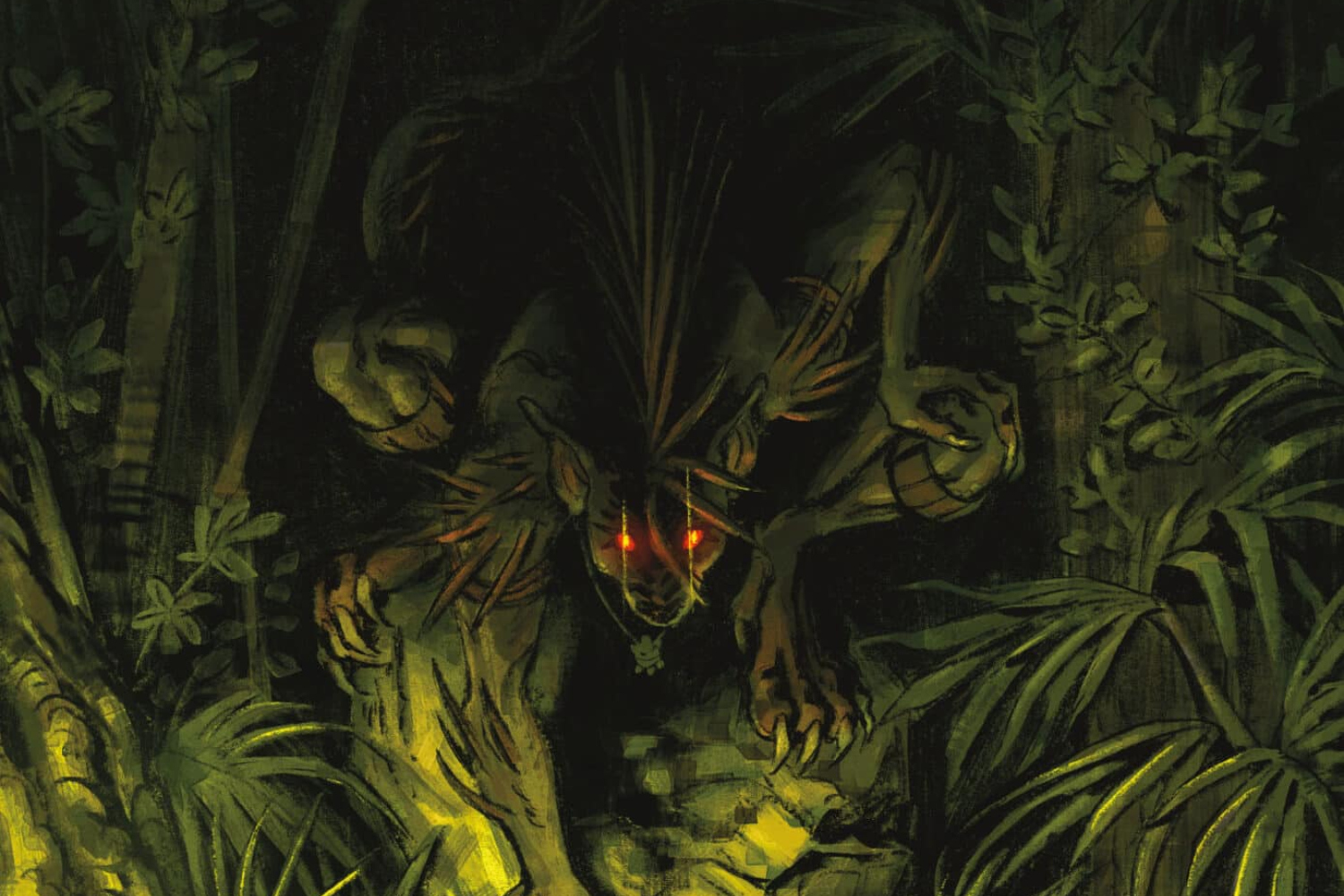

I’ve had The Beast of Borikén on my mind for several weeks now, and I’ve long since made up my mind that it’s a damn good book. Writer Julio Anta understands the complex socio-politcal makeup of Puerto Rico, and distills that effortlessly through the lens of a monster movie. And the rest of the team — artist Daniel Irizarri, colorist Patricio Delpeche, and letter Lucas Gattoni — expertly translate that larger vision into this rich exploration of the island and its makeup (both cultural and geographic) that honors its essence while meeting the story’s genre demands.
But in the days after a rousing sweep by Democratic Socialists in New York (and even beyond), I’m finding new ways to really engage and connect with The Beast of Borikén.
Because the sweep should’ve been good news for working class folk everywhere — instead the New York “kerfuffle” only clarifies that real life is as much a genre-bounding monster story as any actually fictional tale. You’ve got your good guys, your bad guys, and you’ve got those players somewhere in between. And it’s through that messy, complicated exterior that teaches us something, and shows us the uneven arc of history, culture, and politics.

Main cover by Daniel Irizarri. Courtesy of Dark Horse Comics.
Our lead, Loli Flores, is clearly the Democratic Socialists. Sure, that’s obvious enough: Loli is an organizer who is fighting for the very soul of Puerto Rico via organized action. But the connection goes even deeper still: What you’re seeing with this “new” wave of deeply progressive leads is all about fostering connections — between past and present, people and the land, and the populace versus commerce. Anta clearly understands this “activist” class, and has positioned Loli in this perfect place to be both a human we deeply care for and a stand-in for certain political “messaging” without ever once feeling so heavy-handed.
In fact, Loli’s struggles with her deceased father (and the grief she carries into her relationship with her mother) are a perfect melding of the personal and political. Her speech at the end of Beast of Borikén #1 isn’t just absolutely stirring; it makes real the long journey of pain and the renewed desire to fight, and reminds us all that the path forward is both a systemic and personal overhaul. She grapples for the very soul of this book, and does so with a courage and vulnerability that feels like the best commentary about the power and ever-evolving face of activism.

Courtesy of Dark Horse Comics.
Now, the villain here is also a smidgen obvious: real estate developer Simon Hunt. That fine, extra blonde hair and exaggerated features feels like a deliberate way to typecast him from his first in-panel appearance. Only as Anta and I discussed across our chat, Hunt isn’t purely bad; he’s just deeply misguided. So, in a way, I think he splits the difference between establishment Dems and Republicans. For the former, he clearly understands the history of the island, and even believes Loli to be this righteous “foe.” But he’s the former because while he may know better, his pursuit of power and self-gratification prove to be his true contribution. (OK, maybe the lines Hunt represents aren’t so clear cut…)
I, like so many others, genuinely love a deeply complicated bad guy. I’ve said it before, but him being a mere caricature would mean this book felt decidedly empty and lacking right away, and that the creators weren’t focused on true systemic reevaluation and change. With Hunt being not good but someone with at least an understanding, he can be grappled with accordingly. (To be clear: I believe Republicans aren’t nearly as redeemable, but like any good story, there’s hope for a happy ending no matter how unlikely.)
In fact, that makes Hunt’s role almost like wish fulfillment. Seemingly gone are the days that conservatives could be seen as legit players in our political ecosystem. (That explains why Hunt is as much a representative for the current Democratic establishment — he represents an evil born of ignorance rather than cartoonish evil, and that feels more manageable.) Eventually, I could see Hunt being beaten not with claws and teeth but an earnest recognition of his true impact. And that to me feels like part of Beast of Borikén‘s true promise of using genre stories to examine, uplift, and get us engaged in these vital conversations.

Courtesy of Dark Horse Comics.
So, then, what’s that make our beast, the Chupacabra? Well, I think he’s us — the average citizen. I can’t tell you how many times in the last decade I thought I’ve lost my mind. That I’ve been subjected to increasingly feckless politicians, and each one has eaten away at my reserves of patience and understanding. When the Chupacabra tears up a groundbreaking ceremony — the art team kills it with the right mix of blood, chaos, kinetic movement, and strategic views/perspectives — I couldn’t help but cheer him on.
The average citizen (of America, at least) feels that same, ever-boiling rage, and we remain undeniably caught between this simplistic humanity and this increasing desire for bloody justice. Making the Chupacabra the right amount of human (through sparse clothing that whisper his origins/past lives) is maybe one of the smartest things Beast of Borikén could have done.
And the Chupacabra representing us is genuinely a good thing. It’s the creators speaking to some deep emotions, and trying to help us understand and channel those sentiments somehow. It also reminds us of some important lessons, like true monstrosity is often in what you choose to do (or not do) with all that burning rage, and even the most savage heart has something to offer the world. It’s that lesson I think pushes Beast of Borikén beyond just being a proper story of/for Puerto Rico, but touching on any group who has ever struggled with this same extended, structural suffering.

Courtesy of Dark Horse Comics.
The Chupacabra has as much to offer as he does still learn, and depending on your stance toward the story, he may be the best example of this central dichotomy across the entire book. You could make similar arguments for Loli and Simon, and they’d be good fits — all that just proves how invested this book is to meaningful character work. But for my money, the Chupacabra has to find the center space between rage and vulnerability, and that lesson feels perfectly suited for life moving forward.
And there’s so much more still that sings across Beast of Borikén #1. The art team’s general depiction of Puerto Rico (the singular architecture, the relationship between man and nature, the mix of old and new, etc.) feels like a character in and of itself, and adds to our immersion in the book’s thematic core. The trauma Loli deals with may get minimized to some extent, but it maintains a steady beat to inform Loli’s arc. (Again, Beast of Borikén excels at emphasizing its bright, burning humanity to augment or empower the proceedings accordingly.)
Even the look of the world feels modern enough, but there’s that subtle haze of a monster film, and I love how that further positions the genre trappings in some interesting ways. And, of course, that closing shot where the Loli-Chupacabra connection doesn’t just grab our faces, but it brings all that thematic work across #1 home in this tight, doubly visceral little bundle.

Courtesy of Dark Horse Comics.
Even if you weren’t in the same brain boat as me coming into Beast of Borikén, it’s likely you’ll find all or most of what I see that makes this book special. But in my case, it isn’t just that this book feels massively relevant and timely — even as that’s totes the case. (I didn’t even mention the still very much happening, still super troubling development efforts across the island.)
It’s also that Beast of Borikén feels somewhat “evergreen” in some rather important ways. It re-approaches monster stories with new ideas and eyeballs; it focuses on Latin characters in a way that’s uplifting but still genuinely tailored to some shared wants/needs; and it balances terror/horror and optimism in a way that feels suited for modern audiences.
But whatever you take away from Beast of Borikén, let it leave you just as stoked as I am right now. And whether that’s for the personal, political, or some combination thereof, it’s already clear that this title is going for the heart and the throat in gloriously equal measure.




You must be logged in to post a comment.