

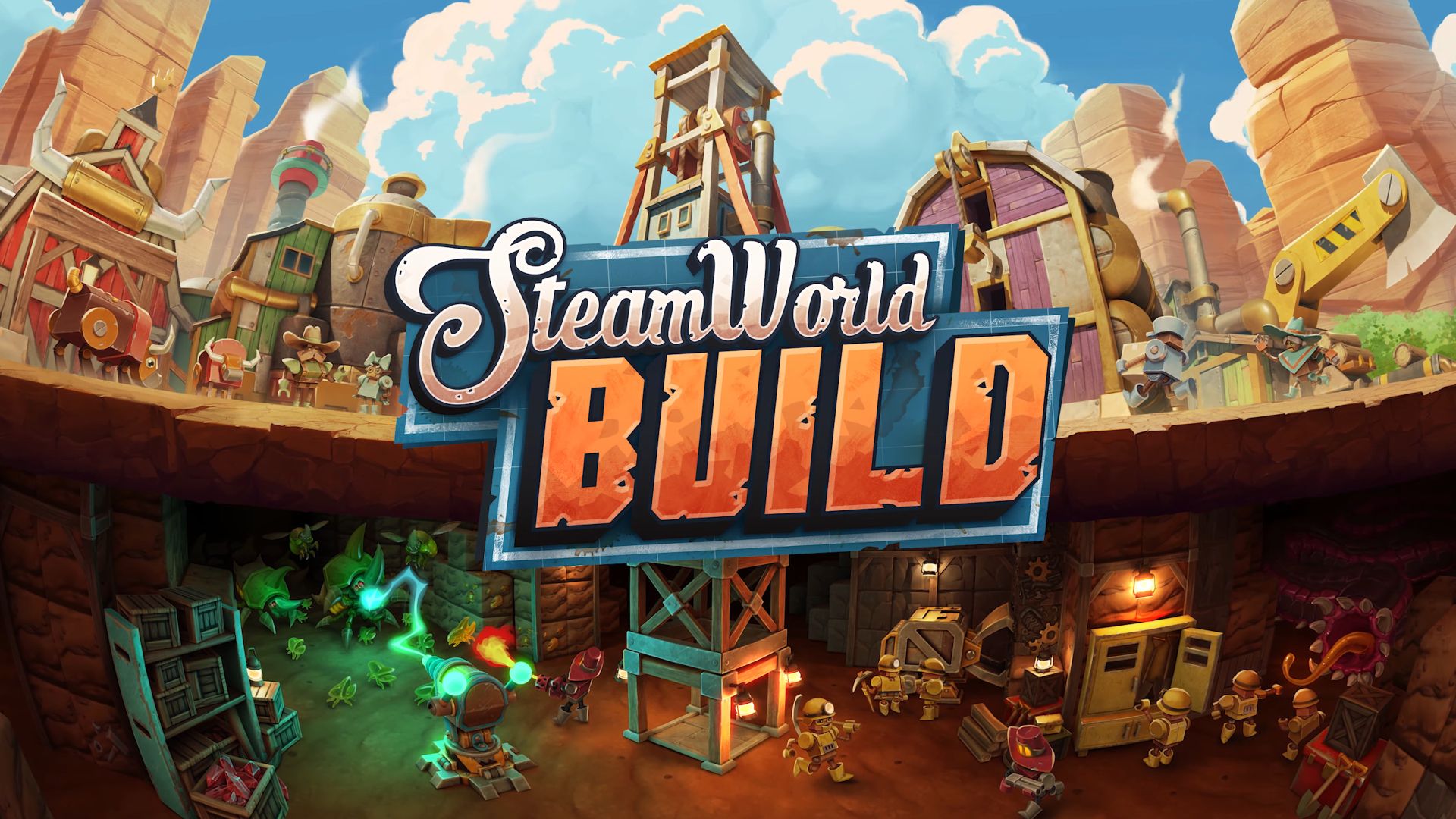

The world is an arid wasteland, seemingly devoid of life. Confusing remnants of a long-evaporated society dot the landscape, abandoned curlicues of iron rails spiraling and looping in the bright desert sky. Though it shouldn’t be possible, there is a cacophony rising from beneath the ground – the clanking of many pickaxes. A city is rising from the dust, peopled by an eclectic and industrious population of steam-powered citizens.
All of them are doomed.

SteamWorld has been a busy place since its inception thirteen years ago. We have mined its treacherous caverns twice, taken its inhabitants into space, and explored the fairy tales of its people. Developer Image & Form has developed a blanket aesthetic in which they can swaddle games of any genre and any gameplay style. It is a preconstructed core concept, with bare traces of airy plot, and it is delightful.
The setting has been applied to a compelling set of genres. The first game was a little-known DSi tower defense game, but it was with the second outing – SteamWorld Dig – that the world began to gain notoriety. A novel take on the Metroidvania, Dig (and its later sequel, Dig 2) began to build a sort of overarching narrative; each game puts us somewhere on a timeline, right before or right after the massive detonation of the SteamWorld itself.
With SteamWorld Build, I&F has dropped their creation atop a generous — if simplified — city builder. As with Dig 2, we are placed in a narrative with an implied ticking clock: these are the final days of SteamWorld. As in Dig 2, Build sets out toward an end goal of gathering enough resources to build yourself an escape rocket.

Also as in Dig 2, there is a sense of nefarious tampering with the planet’s structural integrity. The further one digs down, the more one approaches the remains of a lost civilization (humanity), and the technological origins of the planet’s destruction – creatures of much a much higher tech than your rickety, steam-driven population.
SteamWorld Build isn’t a fully narrative game – the story mode taps out after only a few hours – but city builders are rarely about their stories. What matters is the sandbox engagement that opens up to you after that story (though you can skip the story altogether), and while Build doesn’t have the underlying systems that a SimCity might, the interrelation of its buildings and upgrades presents its own puzzling take, one that compels the player to create more and more cities. Optimization is the name of the game – how can you build a city better?

Juggling your buildings is a major factor of the gameplay. Certain buildings must be placed in proximities of others so that the latter can be upgraded. A very early example: you’ve got yourself a row of houses for your standard steambot workers, and shortly discover that those workers now need to become engineers. Engineers need moonshine (obviously), and so now you’re struggling to figure out how to put a glass factory, a distillery, and a bar within range of your worker’s homes so that they might be readily drunk/fueled enough to tackle harder projects.
All of this seems fine enough, but the game doubles down on its complexity with the introduction of mining. In search of resources, your steambots are forced downward. This means that, as you manage your city above, you are also building and organizing a mining camp below, tapping veins of ore and tools. There are further levels of the mine – rarer resources to be tapped – which means you find yourself building more and more communities. As you bounce back to previous levels of the mines to automate them, you’ll also discover that there are things down in those mines that want to kill you. This means you’ve got yourself the further complexity of a sort of auto-battler/tower defense hybrid.

This complexity — the juggling of multiple communities, the drive to build better, more optimally — will keep you coming back to the game, especially given the fact that every map you “complete” unlocks new buildings to utilize and benefit from. Add to that the recently announced seasonal content and it seems you’ll be coming back every so often even after you’ve moved on to a new RPG or shooter.
SteamWorld Build doesn’t exactly reinvent the genre, then, but it creates its own unique challenges. Longtime fans of the series will be delighted to return to SteamWorld’s clanking aesthetic trappings, but, as with all the SteamWorld games, the fresh take on a fan-favorite genre will be enough to hook even the most avid of world builders. If any civilization sim of 2023 is going to carry you into 2024, it’s this one.




You must be logged in to post a comment Login