

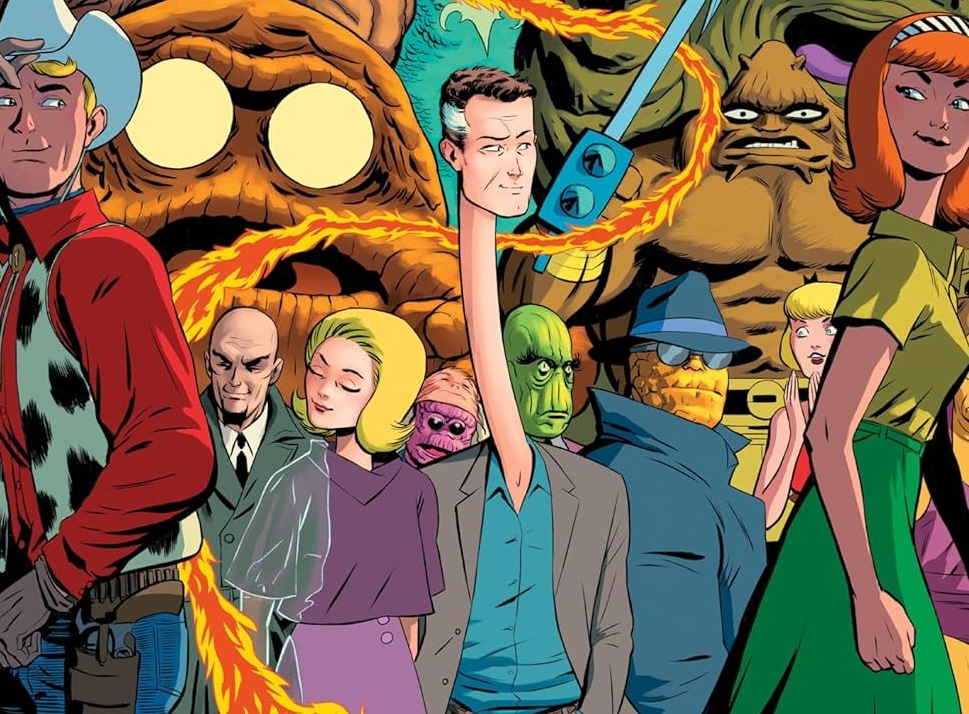

It seems unlikely that we will ever see an Epic Collection of Love Romances or Teen-Age Romance. There doesn’t seem to be a vocal fan outcry for Complete Collection treatments of Gunsmoke Western or omnibus hardcovers of Millie the Model. Indeed, most of the pre-Marvel Universe comics – or comics that were retroactively set in the Marvel Universe – seem doomed to a sort of trash-heap adjacent obscurity.
Most of the comics reprinted in Marvel’s celebratory August 1961 collection – originally an omnibus, now out in trade paperback – belong to that obscured pre-history of the publisher’s non-super output. That month saw the publication of Fantastic Four #1, the book that ostensibly saved the company from disappearing alongside so many comic companies of its day.

This cover is just … so much.
Marvel Comics
The book collects not just Fantastic Four #1, but every other issue that Marvel was publishing at the time. Presented in chronological order as they appeared on newsstands throughout the month (and two issues released the month following), it showcases a company desperate to find a hit, regardless of genre or style. From teenage gag comics to westerns, romance, and the era’s ubiquitous sci-fi, the only genres notably absent from the bunch were horror, which had been all but banished by the Comics Code Authority, and superheroes.
The books range not only in genre but in style. Both Kathy and Life With Millie are shamelessly visual and narrative knock-offs of the popular Archie Comics, while the sci-fi anthologies smack of then-vanished but much more effective EC books that inspired them.

Marvel Comics
Disparate as they may be, there is one unifying factor: each of the dozens of stories collected here was plotted by Stan Lee. Many are scripted by his brother, Larry Lieber, but all of them bear Stan’s workhorse touches: he was the fastest writer in the biz. From silly teenage yearnings to trips into the second dimension, Stan and Larry did it all.
As might be expected, the artwork is disproportionately handled by Jack Kirby, counter-pointed here and there by Steve Ditko’s lanky weirdos and Don Heck’s rigid robots. The Archie imitations are handled by Stan Goldberg, which is strange because Al Hartley – who would later go on to monopolize the art for Archie (and license those characters to tell born-again Christian stories) – is tapped to handle the romantic Linda Carter, Student Nurse.
With such a small stable of talent cranking out at this volume, it isn’t surprising that some ideas got recycled. There are two stories here where aliens attempt to invade Earth through someone’s television set. The Fantastic Four aren’t the only ones bombarded by cosmic rays, here, and Ben Grimm shares his orange, rocky hide with “Sserpo, the Creature who Crushed the Earth”. More interesting are the stories that hint at now-famous stories yet to come, like the Spider-Man analog in “The Spider Strikes” (rather than giving a fateful bite, the radioactive spider becomes a giant). There are even smaller, likely accidental similarities: a Dr. Droom precedes Dr. Doom, a robot named X-35 presages Jack Kirby’s X-51, the Machine Man.

I cannot convey just how much Orrgo delights me.
Marvel Comics
Like the characters who retroactively launched the Marvel Universe, Namor and the Human Torch (in Marvel Mystery Comics, 21 years before Fantastic Four #1), a surprising amount of the characters and creatures found in August 1961 were eventually folded into Earth-616 continuity: adorable would-be world-conqueror Orrgo, from Strange Tales #90, would later deal with A.I.M., for instance. Linda Carter would eventually become the Night Nurse. And, perhaps most famously, Patsy Walker would become a superhero in her own right upon adopting the Hellcat persona.
No, we might never see archival collections for every one of these titles – Kid Colt will likely be relegated to occasional Western revival stories, and Patsy’s jealous, woman-hating failures will forever be forgotten in favor of ass-kicking. Thankfully, we have August 1961 to provide the deep context of the company before its ascension.




You must be logged in to post a comment Login