



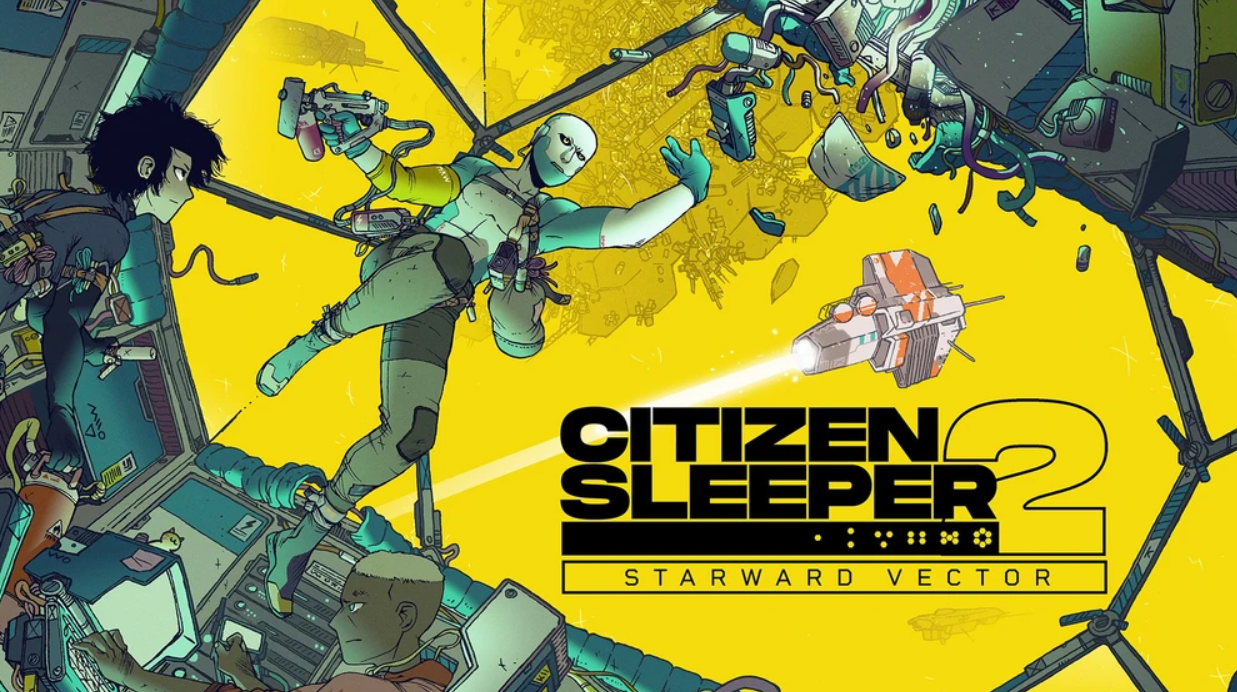

There are few places less hospitable than the cold and dark of space; no matter of technology can completely separate a person from the sheer fact of the vacuum, the airlessness, the frigidness. All it takes is a pinpoint of failure in the hull of whatever craft that person might be nestled inside for the vacuum to intrude.

That looming concern of claustrophobia and knowledge of the fragility of existence is the perfect setting for Citizen Sleeper 2 Starward Vector, a game that puts the player under the constant pressure of stress. There is always a feeling of precarious stability in Citizen Sleeper, of being under the whims of the mechanisms of both the universe and the game itself. Not only will space get you, so will capitalism, crime, and the sad fact of your decaying shell.
That’s because Citizen Sleeper 2 functions on ceaselessly ticking clocks – a never-ending parade of them. These clocks – which spring from the game’s TTRPG inspiration, Apocalypse World and its Powered by the Apocalypse system – are quite literal countdown clocks, and they tick down based on the passage of in-game ‘cycles’; every time your character sleeps, you get closer to the clock’s expiry.
At the beginning of the game, your Sleeper, a digitized mind placed into a synthetic (and slowly failing) body, awakens to learn they are being hunted by a sort of vague crime boss named Laine. When the Sleeper and pilot pal Serafin escape Laine’s clutches, they get in their spaceship and jet away to another part of a massive space station.

But Laine is coming.
Armed with a limited number of ‘moves’ (represented by dice rolls) and an ever-dwindling pile of resources, the Sleeper and their slowly expanding crew must worry about the tragic struggle for survival in a post-corporate hell space. They must make credits, they must buy food, they must uncover information that can lead to jobs, discover new locations on the space station, and the repair of the Sleeper’s body itself.
The damnable thing is this: every morning (cycle), the Sleeper rolls five six-sided dice, and those five dice represent the number of actions they can take. Low dice rolls mean they might fail in their endeavor. To find work will take up to eight actions; work itself takes an action. Finding a lead on a repair might take two dozen more actions (through a series of ticking events).
Laine will discover the Sleeper’s location in 16 days. There are not enough dice. There will never be enough dice.

Like existence in an inhospitable space, survival in the crushing reality of ultra-capitalism is unlikely – a single point of failure in the wall between yourself and bankruptcy means depressurization. A permanent gameover feels certain around all corners. Using your actions might just be spinning your wheels, and you’ll find yourself needing to rest without having achieved anything.
Tick tock.
What separates Citizen Sleeper 2 Starward Vector from its predecessor is a small boon of new systems, space flight, and managing a crew chief among them. While the first game saw your Sleeper desperate on a life-sustaining drug, this game does away with that crushing factor, but that doesn’t mean life is any easier. What the new systems do is make your desperation wider.
For instance: jetting off to salvage from a dead spaceship sets back Laine’s clock (narratively, you’ve made yourself scarce). But while on that job you’re faced with impossible tasks like hacking computers or cutting apart hulls, which means plenty of cycles are needed to complete the tasks at hand. Alas, you only have so many supplies aboard to keep you going for further cycles.
This leads to a mechanic literally named ‘stress’: your sleeper and their crew take points of stress damage for failure in their tasks, for days without food, for not quite succeeding before the ticking clock counts down. And get this: too much stress breaks your dice. You will have one less action for each broken dice. What’s more, the materials needed to repair your dice are rare.
The game looks to hobble you at every turn. The pressure mounts.
For all its literal and in-game stress, Citizen Sleeper 2 is a joy to play. Utilizing visual novel aesthetics, lone developer Gareth Damian Martin’s writing is dazzling. Each character – gorgeously illustrated by comic artist Guillaume Singelin – is loveable, and the more you work with them the more you come to see that they have depth, personality, and passion. What’s more, all those ticking clocks – the ones that make the player feel as if they’re drowning, unable to manage – are made narratively vital, driving the player to struggle because the story demands they uncover more and more of it.

The truth is, of course, that those ticking clocks might really spell the Sleeper’s demise; each failed clock takes you to a new narrative branch, a new location, a new scenario (if Laine finds you, you might just skip town to the next location). This aversion to failure doesn’t weaken the game because of that self-same writing. If you fail a clock, how much story are you missing? How many loveable characters and compelling story beats have you cut yourself off from?
The failure of all this pressure won’t affect the game’s functionality, but it will affect your personal emotions; the stress is coming from within you as much as from the game. Through clever, empathetic writing, Citizen Sleeper 2 has made your inner space just as precarious as all that cold, distant space. With air-tight game mechanics and invaluable heart, Citizen Sleeper 2 Starward Vector builds upon everything that made the first game great: its stress, its love, its style. It opens up space travel, yes, but it also opens up all the possibilities the first game suggested.




You must be logged in to post a comment.