

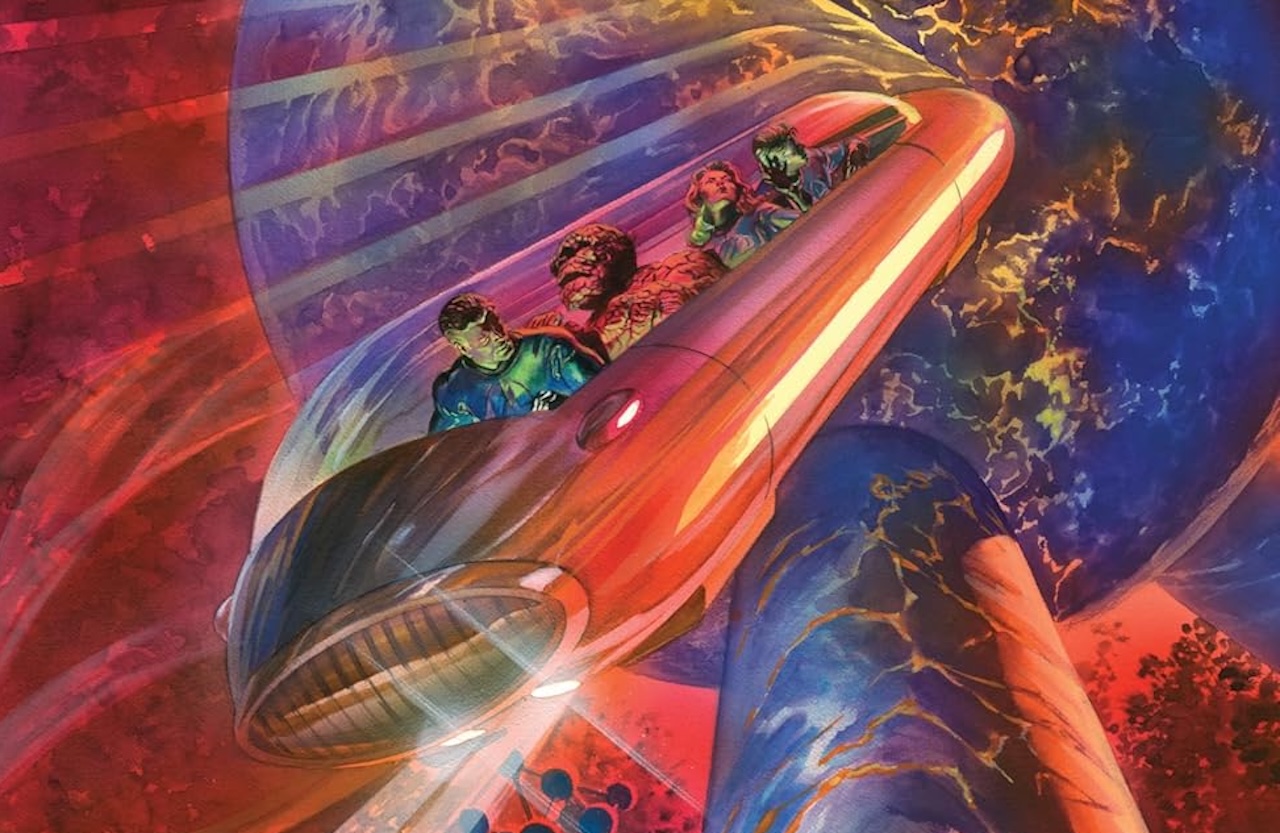

Fantastic Four comics have been many things: revolutionary, stodgy, out-of-touch. They have been used as massive, Universe-changing platforms, and they have been complex, architectural masterworks.
What Ryan North and company’s current volume of Fantastic Four has above most other incarnations of the book is absolute, grinning joy.
There is a joy for science, a joy for family, and a joy for the property itself. Throughout the series, we’ve seen each character get their time to shine, whether that means Sue gets to shine as an archaeologist or Ben gets to solve a confounding science mystery. Nearly every issue introduces a real scientific concept – things like the OMG particle, the inverse-square law, or the Earth-developing Theia.

Marvel
Uncomplicated by events or pressing ongoing narrative arcs, the issues in Fantastic Four by Ryan North Vol. 5: Aliens, Ghosts and Alternate Earths are allowed to flourish as themselves. Mostly self-contained, riotous, and filled with their trademark joy, these issues mark some of the best stand-alone Fantastic Four stories of the last decade. It’s here that the scientific concerns listed above get their due; it’s also here that Johnny and Reed go on a Halloween night adventure concerning Hellmouths, ghosts, and a mystical skull that infinitely vomits blood.

Marvel
Whether Johnny is falling in love with an alternate-earth life form or Nicki Masters-Grim is learning her Skrull-centric self-worth, the book also embraces a sort of emotional openness often neglected by a franchise where Mr Fantastic can be seen as cold and careless. It’s a welcome warmth in a Marvel Universe built around conflict and cosmic-level threats. While the Avengers are off fighting troops of gruesome space baddies, the Fantastic Four are basking in familial love.

Marvel
Some of that contrast can be seen in the fact that these issues are bookended by major events – the horrific Blood Hunt on one end and the currently-running One World Under Doom on the other. Aliens, Ghosts and Alternate Earths allows for a breather between such Universe-spanning epics, and while the book has its ongoing narrative threads, these issues rely only on themselves for conflict and support.
And despite all their warm-feeling heart, these issues do offer conflict: the Earth nearly gets destroyed twice – once by extraterrestrial nuclear Armageddon, once by rewritten history – and classic baddies Mole Man and Doom make appearances. These conflicts are so suitably scientific and weird that they would not feel accessible in any other book – even science-minded Spidey couldn’t support a story about subatomic particle spaceships. This book is inherently a Fantastic Four book.
That means that Aliens, Ghosts and Alternate Earths might be the perfect volume of this volume for new or disconnected readers to pick up: one can read these six issues without feeling lost and understand just what makes this series so great.




You must be logged in to post a comment.