

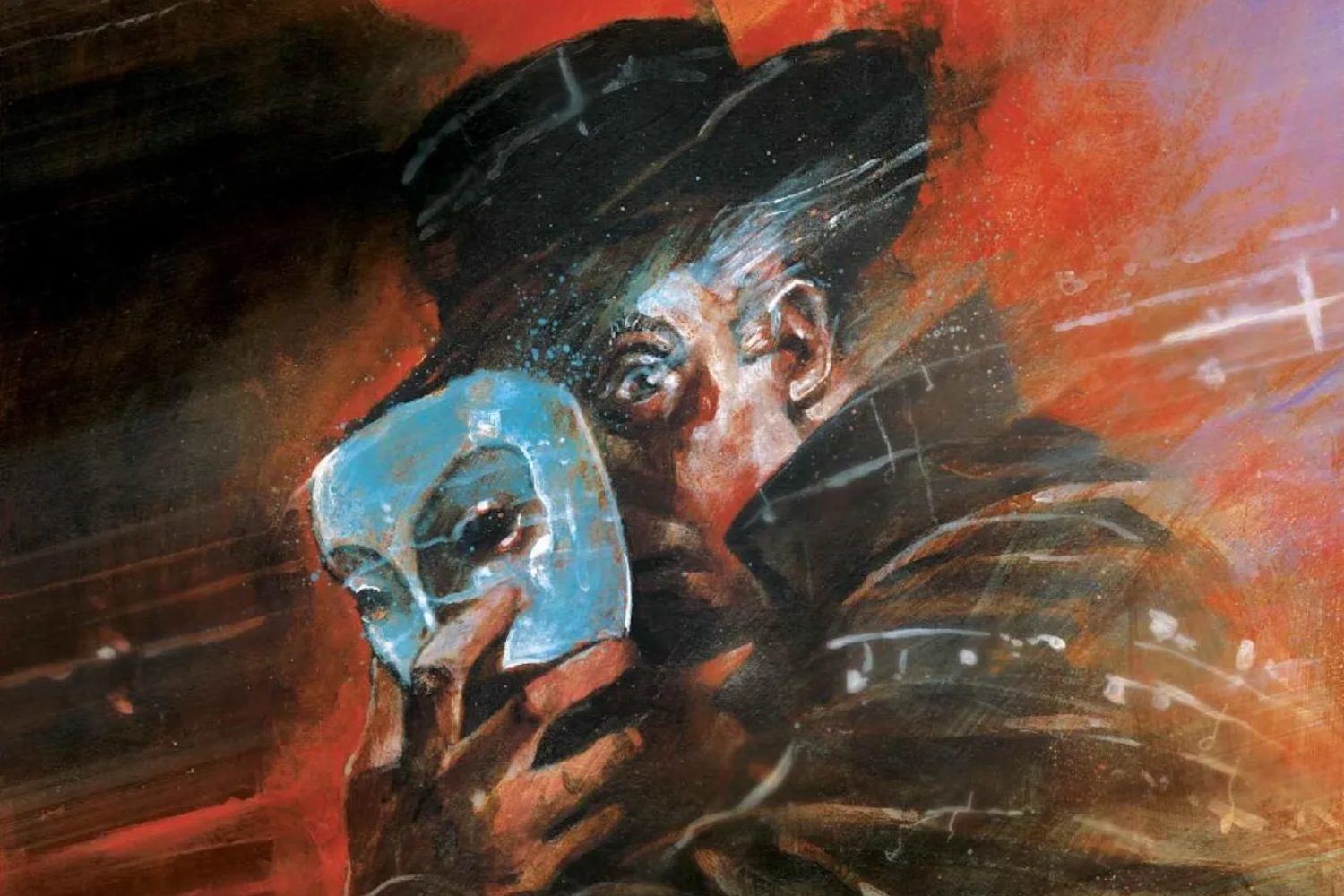

With the Universal Monsters line, Image/Skybound have had quite the success updating some true horror classics.
Dracula bite hard with a dazzling adaptation of the novel; Creature from the Black Lagoon expertly balanced nostalgia with creative innovation; Frankenstein lent the creature even greater depth and nuance; The Mummy felt surprisingly poignant and affirming; and The Invisible Man offered an especially harrowing lead in this version of Griffin.
Now, the companies look to extend the streak, as it were, as Tyler Boss and Martin Simmonds team up for Universal Monsters: The Phantom of the Opera.
Just as young Christine Dubois’ theatrical career is on the rise, a “series of violent crimes wracks the Paris Opera House.” Now, with a “mysterious voice whispering from the eaves,” and an “old friend returns to investigate these surprising attacks,” Christine will learn the true face of terror.
Fans of the original stories (mostly the 1943 film) will find heaps to love about Phantom of the Opera. Be it Boss’ tender character development, or Simmonds’ singular depiction of the opera house’s darkest corners, this four-issue story hums with romance, intrigue, horror, and so much power. And with the promise of a “twist no one will see coming,” Phantom of the Opera should have you singing from page one.
Universal Monsters: The Phantom of the Opera #1 debuts next week (February 18). Ahead of that, we caught up recently with Boss and Simmonds to talk about the story and its development. That includes springboarding off the source material, any past ties to the other Universal Monster stories, the Raoul-Christine relationship, and their favorite scenes from the debut.

Variant cover by David Talaski. Courtesy of Image/Skybound.
AIPT: What direction do you get from the higher ups about direction, tone, etc.?
Tyler Boss: The only real directive was to not step on, or make fun of, the source material. Really besides that our directive was that we’d be taking off from the 1943 Universal version of the character and then from there, what story do you want to tell within that framing.
Martin Simmonds: Initially, our editor suggested The Phantom should take on a darker, more sinister feel, more along the lines of Batman or Dracula, which was a great starting point for how I went on to paint that character. Other than that, and the usual editorial input as the work is turned in, we’ve been given a great deal of freedom to take this in the direction we want.
AIPT: We’d talked about the 1943 film being a touchstone. What does that flick do well and what maybe did you instead try to change or adapt?
TB: It’s a visually stunning movie. It’s shot entirely in technicolor and won an Academy Award for best cinematography and set design for a reason. So those aspects of lush color and costuming was something we really wanted to bring into our version. Claude Rains is also so wonderfully tragic in it. Besides taking the look of his mask, I think there’s elements of his performance in our version. The ’43 film also had two Raoul’s in it. One in Raoul Dubert and the other in Anatole Garron, something that doesn’t exist in any other version. There’s an element of misplaced jealousy in there that opened up some new lanes in our story that I don’t think would have crossed my mind if not for the film’s deviation there.

Courtesy of Image/Skybound.
MS: Visually, it’s an incredible film, with wonderful sets and architecture, and great costume design, so that’s something I wanted to retain in the artwork. In particular, the bright, vibrant imagery provides a wonderful contrast to the darker horror elements we have included.
AIPT: Martin, what did you take from Dracula into Phantom of the Opera?
MS: Although I was conscious to not repeat the same artistic approach on Phantom of the Opera that I used on Dracula, there are still techniques and approaches such as directly referencing the film in collage that I carried across. Use of color on Dracula was used sparingly, whereas in Phantom, I wanted to make it bolder and full color throughout, and then boost those colors even more for the music scenes.
AIPT: Could you go into the design of the Phantom? It feels more ghostly, which we’d discussed as being one means of adding even more horror to the story.
MS: Yes, it’s certainly a darker take on The Phantom, and what I like about the design is that we retain an ambiguous element that adds to the mystery and horror. Often, an invisible and ominous presence is scarier than more direct horror imagery. That doesn’t mean there aren’t moments of more brutal, direct horror in this book though, and it’s those highs and lows that create the emotional reactions from the reader.

Courtesy of Image/Skybound.
AIPT: We also talked about translating the musicality of the main story into comic form. Can you talk a little more about that process?
TB: I wrote Martin a very long and annoying note before he started working basically saying “I don’t know how we’re going to handle the music, and here are a bunch of ways we could, but we cannot have sheet music be anywhere near this.” From there, Martin and I had a couple of conversations but really it was all Martin. The crescendos of color, the creeping suffocating hands, all of it.
MS: One of the first things we discussed was how to depict the music throughout the series, and how we could use color as a tool to show the music. After all, we not only hear, but also feel music, so the challenge was to show those sound waves and vibrations as well. That’s why we have incorporated double imagery alongside boosted colors in these scenes. The lines emanating from Christine’s head and chest are meant to show the use of the head and chest voices and the blended voice technique that singers employ.
AIPT: The book also does a great job of (as we discussed) Raoul and Christine. Can you talk a bit more about why they need to play a bigger, more substantial role?
TB: In a lot of versions of the Phantom story, Raoul really just feels like the literary element of a foil made manifest and isn’t any deeper than that. The same can be said about Christine sometimes where her motivations/wants/desires are all just boiled down to “love.” And while having clear and defined goals for a character can make for a clearer runway in the type of story you’re telling, the emotionality of our Phantom and what we’re trying to accomplish is a whole lot messier.

Courtesy of Image/Skybound.
AIPT: What’s your favorite moment/scene from issue #1?
TB: I think our opening is really strong, but I’ll go with our ending sequence. In Paris in the early 1900s, their morgue had viewing lobbies. The point was so that members of the public could come and help identify bodies, but in principle, it was a bunch of naked dead bodies on stone slabs tilted towards a gawking public who treated it like an affordable theater. “Let’s see what the morgue is showing today.” Contrasting that against the show that takes place in our haunted house; the Palais Garnier, felt like a really great way to show the two different worlds Christine is being pulled between. Doing it in a way that comics is uniquely suited for. Two images in rhythm and juxtaposition with one and other.
MS: I think the scene with Christine attempting to sing in rehearsals, and the darkness encroaching upon her when she struggles to hit the desired note works well, shows a great emotional progression, and has a good balance of realism and abstraction.
AIPT: Did either of you learn anything from the other Universal stories/titles?
TB: I looked to Martin’s work on Dracula as a good roadmap for where to leave him room, when to pack it in. How his work functions to a reader when showing action versus emotion, etc. Really, just how he arranges real estate on the page. Across the line, too…how an issue ends and how the next one picks up work very differently in single issues versus in collected editions, so just making sure our beginnings and ends are married up in any reading format folks choose to pick it up in.

Courtesy of Image/Skybound.
AIPT: How much does this Phantom of the Opera ultimately deviate from the “main” story?
TB: Hm. I’d say our story is very true to what you’d expect from a Phantom story, but where ours differs is all in service of our versions of the characters.
MS: It’s certainly a darker take on the story, but it’s also a more overt supernatural horror story. The Phantom being a ghost/supernatural entity pushes this version in a different direction.
AIPT: Is there anything else to know about the series, opera music, comics, etc.?
TB: For good or ill, we really tried to make a version of Phantom of the Opera that felt like the ones readers have always wanted out of this story. It’s a gothic horror story with the emphasis being on horror. But it’s still trying to bring an emotionality to it that Phantom fans would expect. I’m very proud of what Martin, myself, and company have made here. If you’ve ever felt the hairs standing up on the back of your necks when in a crowded space, like you know someone just out of sight is watching you but you can’t see them, and that excites you? This is that kind of book.



You must be logged in to post a comment.