

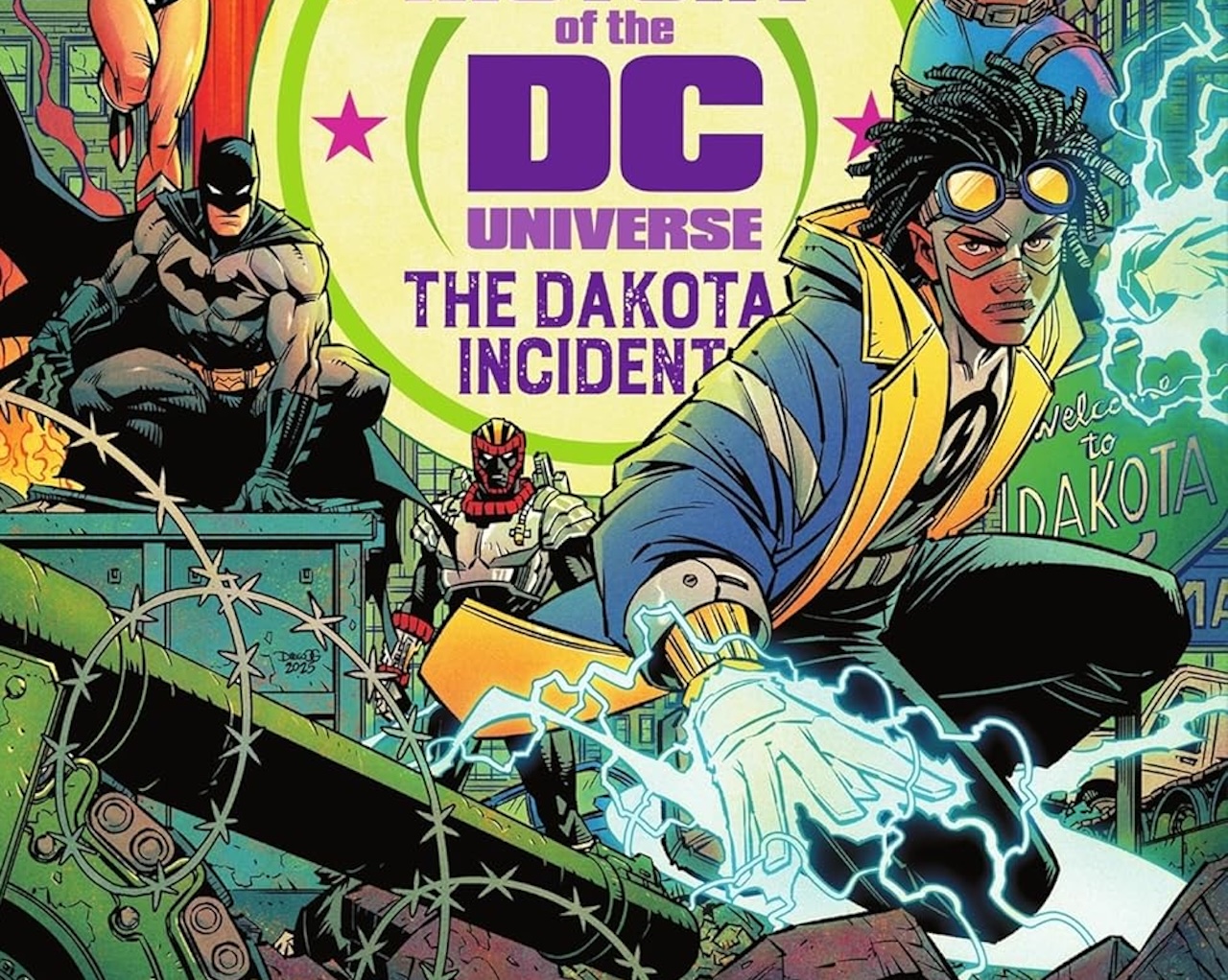

The Milestone Universe lies at an odd crossroads. It’s the first line of comics that proves that diverse heroes and creators can make for interesting comics, no matter how loud a segment of fandom screams on the internet. Yet it’s always felt like DC Comics has never known what to do with the line. The first incarnation suffered from the major market crash in the 1990s, while an attempt in the 2010s to integrate Milestone’s characters into DC’s mainstream canon never took off. (The less we talk about the New 52, the better.) New History of the DC Universe: The Dakota Incident #1 makes another attempt to fold Milestone into DC, but takes a unique approach to the idea.
The Dakota Incident begins in the far future and follows Beacon, who first appeared in Batman/Static Beyond and is best known as the son of Milestone hero Rocket. When a massive ripple through time threatens to wipe out everything in Dakota City, Beacon leaps into the timestream to find out what happened…and discovers that a major incident in the past has changed his future. It’s also sent out ripples that affected the Milestone heroes and their place in the universe, with the most prominent being Static.
A large crew of creators worked on The Dakota Incident #1, and they had the smarts to break it into three distinct acts. Act I, written by Joseph P. Illidge and illustrated by Valentine De Landro, smoothly transitions from the sleek design of Dakota’s future to its past. This gives De Landro the opportunity to illustrate different moments from Milestone’s history, including the debuts of Static, Hardware, Icon, and Rocket. Illidge doesn’t miss a beat, tackling each of these heroes’ origins in rapid succession until he finally gets to the point of divergence.

DC
This tees up Act II, where the creative team of Stephanie Williams, Carlo Pagulayan, and Stephen Segovia turn up the proverbial heat – and by extension, turn Dakota into a battleground between its heroes and the Suicide Squad. It’s also where Milestone and DC’s histories start to collide; the assault on Dakota is masterminded during Lex Luthor’s tenure as President, and the Justice League enters the fray. Williams’ script doesn’t shy away from some of the hard moments – both Black Lightning, who was serving as Luthor’s secretary of education, and Suicide Squad member Bronze Tiger are taken to task by Dakota’s heroes for not picking the right side. Segovia and Pagulayan don’t hold back either, delivering bombastic moments including Icon and Captain Atom trading literally explosive punches that light up the page with glowing reddish-orange light courtesy of John Kalisz.
The final act by Morgan Hampton, Fico Ossio, and Ulises Arreola details the aftermath of the “Dakota Incident” and its impact on the Milestone heroes. It also hit extremely close to home, as Icon and Hardware are forced into a difficult position that ties their hands, and by extension their comrades’. But there’s a spark, if you’ll pardon the pun, of hope toward the end where Beacon runs into the past Static. Throughout the issue, Virgil is depicted as the first of the “Age of Milestones”; it makes sense in both a story sense and a metatextual one since he’s the hero that’s become the de facto face of Milestone. If any hero deserves to spearhead the return, it’s him.
New History of the DC Universe: The Dakota Incident #1 shapes the past and present of Milestone’s heroes while building their future in the DC Universe. The late, great Dwayne McDuffie – one of the prime architects of Milestone – would often quote writer Eudora Welty in his work, particularly her saying, “Never think you’ve seen the last of anything.” Let’s hope The Dakota Incident #1 isn’t the last we see of these heroes.




You must be logged in to post a comment.