

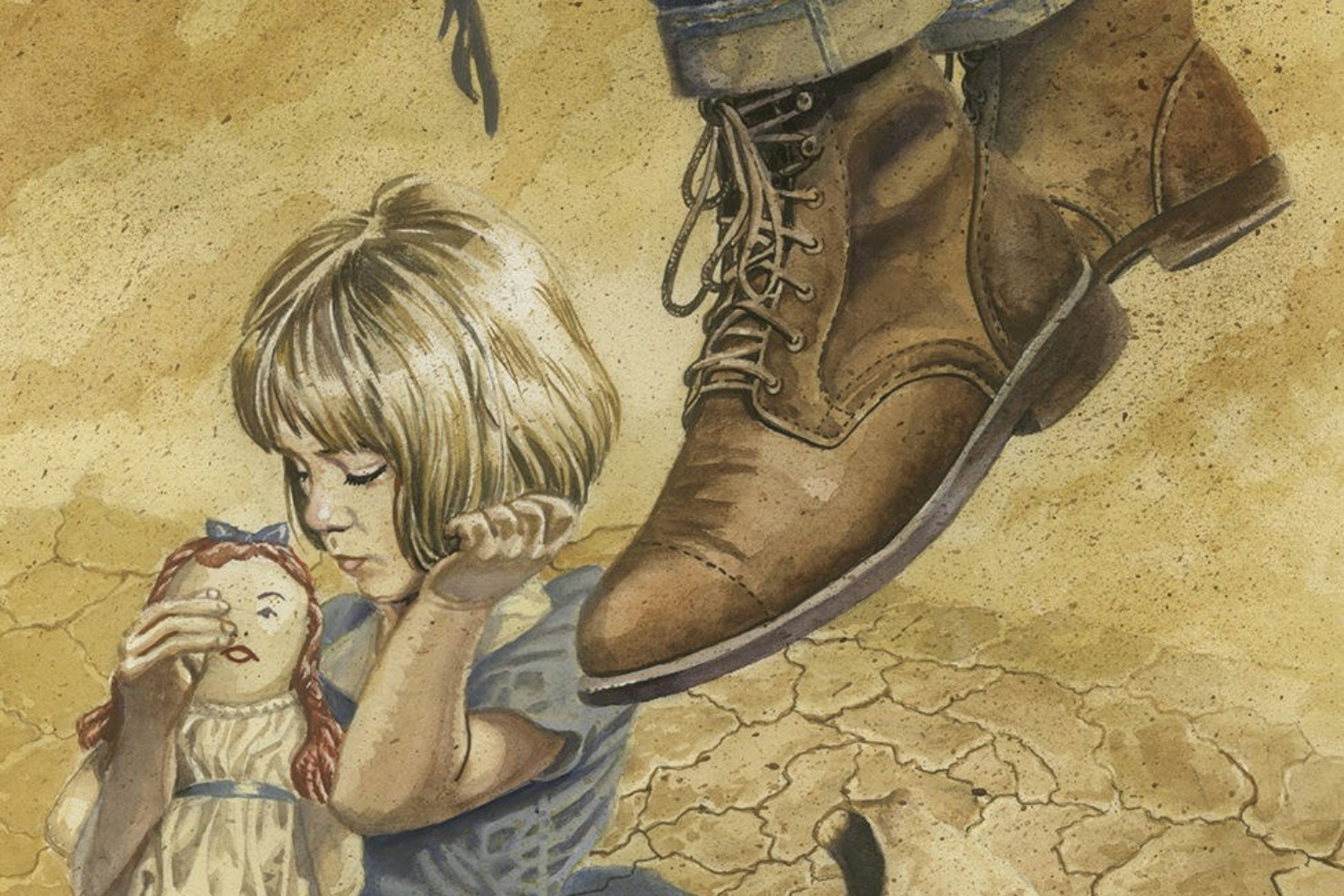

In mid-2024, Image Comics announced a new miniseries featuring one of the more intriguing premises I’ve read in some years: “Yellowstone meets Cormac McCarthy’s Blood Meridian.” The resulting project was Dust to Dust, a different kind of crime story from the minds of writer-artist J.G. Jones (Wanted) and co-writer Phil Bram.
And over the course of the next 18 or so months and eight issues, Jones and Bram delivered a potent tale of a “tormented Oklahoma sheriff and a scrappy photojournalist on the hunt for a serial killer at the height of the dust-choked Great Depression.” Yes, it was very much a story about grief and violence amid a world gripped by profound social, economical, and cultural change. But Dust to Dust is also oddly hopeful, a tale about how we survive this seismic shifts, and the way truth and humanity can cut through the “rot.”
With the eighth and final issue released earlier this spring, this week (5/27) marks the TPB release for Dust to Dust. And given the book’s potency and significance, we decided to touch base with Jones and Bram (via email) to discuss the series. Our resulting Q&A touches on, among other topics, how their friendship informed the story; the long roll-out process; developing and connecting with the book’s leads; exploring the Dust Bowl; and even a future for “similar” stories.
From a promising premise to a robust story, Dust to Dust is truly gripping fare.

Courtesy of Image Comics.
AIPT: I’d read before starting the book that you were friends for quite some time. How did that connection shape the story and your collaboration?
J.G. Jones: Yes, Phil and I first met in New York, many years back when he was working at Rodeo Bar, one of the watering holes for the comics community in Manhattan. Phil was a writer, originally from Oklahoma, and we had both read The Worst Hard Time by Timothy Egan. Talking about this book [about] the Dust Bowl years seeded the idea that would end up becoming Dust to Dust.
Phil Bram: Yeah, like Jeff said, it all goes back to good old Rodeo Bar. Another time and place no more. So we actually started noodling around with this sucker right away after we first met. We’re talking 17, 18 years ago now. I didn’t know jack shit about comics other than being hands f’n down the world’s biggest fan of R. Crumb. It’s pretty bizarre; I don’t remember a single kid that I grew up with ever having any comics around. Maybe it’s a ‘70s, ‘80s Oklahoma thing, I don’t know?
Anyway, back in those Rodeo Bar days in New York, all these cool comic world artists used to come in: Jimmy Palmiotti, Pond Scum, John Czop, Darren Auck, Nelson…they seemed like outlaws to me. I’d heard them talk about JG but he never came in. Then one day he did, and the two of just hooked it up about all sorts of shit. We were laughing our asses off and the beers were flying. But I remember his eyes lighting up when I told him I was from Oklahoma.

From Dust to Dust #1. Courtesy of Image Comics.
AIPT: Now that the Dust to Dust story’s done and collected, how do you feel about it? Are there things you would’ve changed at all or maybe done differently?
PB: Mostly, I’m just blown away by Jeff’s discipline and determination to see this thing through. It’s no secret how sick he got for so many years. And I’m so f’n happy he’s gotten his health back enough to enjoy traveling and living life again. I love seeing Dawn’s pics when they’re over there in France. This whole experience has been nothing but cake for me, to be able to see our world come life after all these years. But if I had to do anything differently? Well, I’ve always been a rather spontaneous writer, where I can easily get all excited and intoxicated with new ideas that can take a scene or the entire story on some pretty wild new directions that simply don’t serve the agreed upon script. So Jeff really had to reel me in quite a lot.
But I do think some of that’s good though, to always be punching at the walls a bit and stay wide open and loose. It keeps things alive. So I’ll just say, I only wish I was a little bit easier on myself for it, for taking those chances and not feel so stupid about it. Though Jeff never once made me feel stupid for it. Even when we got into a bind with issue #6 just before it went to print and I got the chance to jump in and try to save the day…I ended up spending nearly a week hijacking the entire storyline and turned it into a freakish Frankenstein-ed half ghost story/half Ken Burns documentary. HAHA.
JJ: I’m extremely proud of the work that we did on the book. I loved writing the characters and doing all of the research. The one thing that I may have done differently was to have the pages completed before we began publication. My original concept was to publish it in a European album style hardcover format, slightly larger than the American single issue format. We even had pipe dreams of adding a soundtrack with the release to enhance the feel of the Depression Era.

From Dust to Dust #1. Courtesy of Image Comics.
AIPT: Do you have some idea about the book’s overall reception? Did people connect with it in a way that you had hoped that they might?
PB: Other than the intentionally slow pace of the beginning, most of the professional reviews seemed positive to me. I had two major concerns weighing on me: Getting that colloquial dialog right as I knew some of my old Okie friends were probably going to be reading it. And in the back of my mind I always thought, “What if Timothy Egan happened to pick this thing up?” His book, The Worst Hard Time, was our Bible. We had to be as historically accurate with all the details as possible (which I believe we were).
JJ: The reception of most of the readers that I have spoken to has been tremendously positive, overall. People seemed to connect with the characters and the story, with the possible exception of one horror reviewer who was disappointed with the low body sound in the first issue. We were trying to build the momentum, and let the reader get the feel of the blight and desperation before plunging into a bloodbath. We were definitely thinking Road To Perdition and No Country For Old Men rather than a Marvel Comics big bust ‘em up.
AIPT: It took the story about 18-ish months to come out. Do you think that helped shape readers’ relationship to the book at all?
PB: I’m not sure. I’ve never worked in comics before, so every aspect of the publishing was all new to me. As for “readers,” it’s so wild who actually read it and who didn’t. I don’t think anyone in my entire family and very few of my friends read any of it. HAHA. But then I have a neighbor here in Canada that says it’s one of the best comics he’s ever read. Lots of people out there in the woodwork seem to love it. I remember Rick Remender telling me it was “really special.” So maybe it is?

From Dust to Dust #2. Courtesy of Image Comics.
JJ: Yes, the slow pace no one’s fault but my own. Phil and I had a massive script that we had crafted over the years, and it was paced for a lengthier format. When the decision was made to go with single issues, I had to completely reformat the script to eight issues.
AIPT: What was the interest in staging this around the Great Depression and the Dust Bowl?
JJ: I’ll let Phil speak to his own connection to Oklahoma, but for me the era and the landscape were fascinating. The Great Depression had already crashed the U.S. economy, which only compounded the misery when the crops failed, and the Dust Bowl began to destroy the agricultural abundance of The Great Plains, which was the American bread basket at the time. What were people to do, choices were only bleak or worst case scenarios.
We said to ourselves, “How could this get any worse?” So we set about finding a way to make it worse.
PB: Well, again, we both read The Worst Hard Time, which was on the New York Times best seller list at the time. Now, even though I grew up in Oklahoma and not that far from the area where the story takes place, I realized I hardly knew a thing about it other than what I had read in The Grapes Of Wrath or had heard in all those great Woody Guthrie songs. Jeff actually grew up more rural than I did. There were just so many bizarre phenomenons about the Dust Bowl I’d never heard of. The static electricity could kill an entire heard of cattle. Plagues of diseased jack rabbits so numerous it looked like the earth itself was moving. Swarms of locusts. It was all so biblical. But it all came down to Jeff saying, “How do we make it even worse? What if we throw in a serial killer? Now no one gets out!” So we turned that Dust Bowl town into a fishbowl.

From Dust to Dust #4. Courtesy of Image Comics.
AIPT: Building off that last question, do you see some connective threads between that era and what we in the U.S. are going through now?
PB: Oh, shit! Yeah, that’s really the whole meat of it for me. The chickens always come home to roost. Jeff can attest, way before there was any mention of Trump running for office, I remember us both agreeing that Hillard Green, our mayor, was sort of part Trump/part mayor from Jaws. But my favorite aspect of this entire story goes back to the WWI connection. The Dust Bowl most likely would’ve never happened without the demands of that war. And one of the main hooks for both of us was when we realized just how similar a lot of the visuals were to a WWI battlefield, with the struggling fences and no trees and dead cattle and bones and nearly everything else half buried in the earth. The opening pages of issue #5 really lean into this.
JJ: We definitely had some themes that resonate with the current era; ignorance, environmental devastation, greed, and abuse of power. It’s the same old human condition, the same foibles and misplaced motivations.
AIPT: I also like that one of our leads was a photojournalist. Why was that the character and their job the right pick for this specific tale?
PB: Ah! Our gorgeous spitfire, Sarah Grange. She’s a total Dorothea Lange ripoff. Jeff and I are both photojournalism freaks. I love the darker stuff, the war photography stuff. She ended up being much more crucial to the story than just a love interest. She’s sort of the eyes of the reader and it really adds something having her perspective. We saw her so much like Cate Blanchett, [and] Jeff just drew her as Cate.

From Dust to Dust #5. Courtesy of Image Comics.
JJ: We both loved the character of Sara, the photojournalist. She was originally based on Dorothea Lange. We wanted to have a character to come from the outside and act almost as a witness to the devastation and of the region and the evens that unfold in Dust to Dust. Of all our characters, I would love to follow her narrative in further adventures.
AIPT: Is this closer to straight crime or maybe crime and horror? Did that distinction matter?
PB: Though many of the events are horrendous, I wouldn’t call it “horror”. This is a story of what can happen to humans when they are pushed to their limit and backed into a corner. When greed meets desperation.
JJ: I think that it does matter, at least for me. Horror, it turns out, is other people, to paraphrase [Jean-Paul] Sartre. We wanted to keep Dust to Dust rooted in the actual events of the era, rather than leaning into the fantastic. People are bad enough, [and] we didn’t need to add a supernatural element.
AIPT: What did it mean to release this as part of Giant Generator? Did that association help?
PB: It seems like Jeff and Rick Remender have a special bond. I remember early on before we had a finished script when it looked like another publisher was going to do it, but they wanted Jeff to get rid of me and bring on a big name writer, but Jeff said no f’n way. I will never forget that.
JJ: It meant the world to publish under Rick Remender’s GG imprint. I had pitched Dust to Dust to a number of publishers before, but there was never a good fit. GG was ultimately instrumental in allowing us to make the story the way we wanted it. They were very patient with me and helped guide us through the entire creator owned process.

From Dust to Dust #8. Courtesy of Image Comics.
AIPT: Do you have a favorite moment or page/panel from the story at all?
PB: I was proud of myself for coming up with the Gas Company Bill idea in issue #6. It really clamped the down the vise on the mayor with a single simple image. And the rabbit drive in that same issue was always one of my favorites. It’s such a violent bizarre event to have after Sunday church. But of all of pages of this thing, I’d have to say the confrontation that Meadows has with the mayor out on the road in issue #3, with the dead bodies and the buzzards and the gas can that’s now mysteriously gone, is my favorite. It’s the pacing of it and the dialog. Everything about it works.
JJ: Possibly Meadow’s dream sequence where the Thark from [Edgar Rice] Burrough’s Mars books shows up in the Oklahoma landscape. That was fun.
AIPT: Could we see more tales in this story’s vein from the two of you? Any other books in the works instead?
PB: To me, that’s the beauty of this thing. It’s wide open really as it’s the place and time period itself that’s the real character. I’m desperately writing my own book right now while raising two boys and working multiple jobs and even making art again, but if Jeff was hell bent on it, I’m sure I’d be down.
JJ: I would love to follow Sarah’s adventures in much the way Blacksad tells different stories from different years and locations. I do have several new projects in mind or in the works, one of them reprises a character I created over 30 years ago, Rant. But I always have four or five projects under my hat at any given time.
AIPT: Is there anything else we should know about Dust to Dust, the Great Depression, comics, the Dust Bowl, crime stories, etc.?
PB: I think I’ll leave you with my favorite Henry Miller quote from The Air-Conditioned Nightmare where I also lifted the town name of New Hope from in homage: “There is suffering and misery everywhere throughout this broad land. But there are kinds and degrees of suffering; the worst, in my opinion, is the sort one encounters in the very heart of progress.”
JJ: Dust To Dust was a labor of love for me. I touched on era in an earlier story, Strange Fruit, set in the Great Flood of 1927. So That’s a flood story and a drought story; I guess I’ll have to find another horrible event for my next tale.
The Dust to Dust TPB is out this week via Image Comics.



You must be logged in to post a comment.