

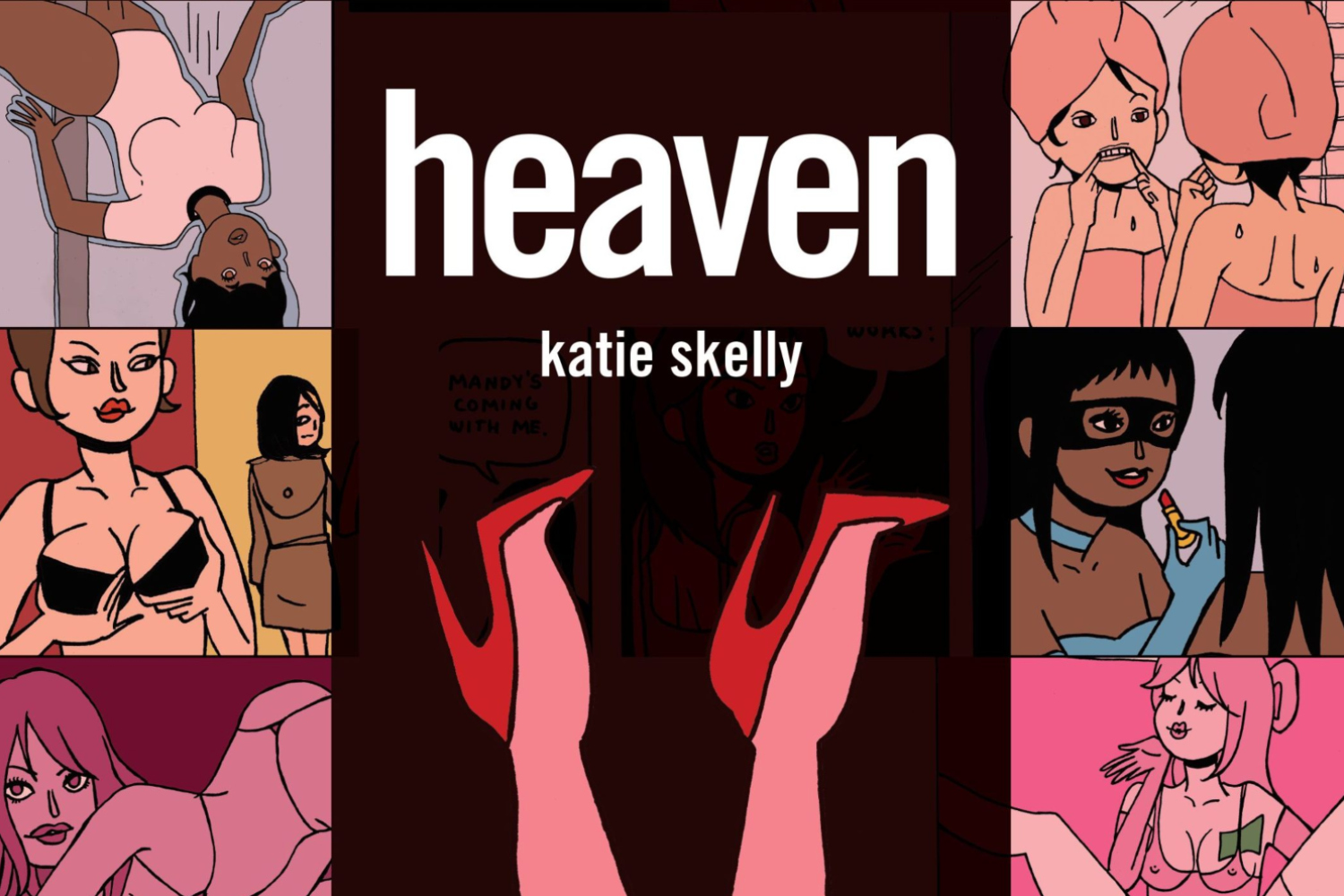

With Heaven, Katie Skelly delivers a haunting coming-of-age story wrapped in neon lights, supernatural mystery, and emotional uncertainty. Set around a strange desert strip club (that might not actually exist), the graphic novel follows Dolly, a young woman struggling to redefine herself after losing the identity that once anchored her life. What unfolds is a surreal meditation on belonging, transformation, and the terrifying freedom of early adulthood.
In our conversation, Skelly digs into the dreamlike origins of Heaven, how the pandemic shaped its sense of place and absence, and why this story feels like a farewell to the “cool girl” archetypes that have defined much of her work. We also discuss giallo influences, the emotional weight of growing up, and how the project became her most personal comic yet.

Courtesy of Fantagraphics.
AIPT: Heaven centers on a strip club that feels almost mythological, something people aren’t even sure exists. What drew you to that kind of liminal, maybe-not-real space as the backbone of this story?
Katie Skelly: I started writing the story during the pandemic, which changed my life quite a lot. Physical places kind of became the enemy, and all these places I loved were closing and only existed in these reviews online, like ghosts. I wanted Heaven the strip club to sit on shaky ground like that. It’s a place beyond control and physics, and you have to figure out why.
After I finished making the book, I went to Japan for the first time and was looking for a shop called “Katie Tokyo” in Ebisu. Google told me it was open, but when I arrived where it was supposed to be, it was totally gone. I almost ended up in someone’s apartment looking for it. So I was like, “Oh, yeah, this is a very odd experience!”

Courtesy of Fantagraphics.
AIPT: Dolly is coming off the loss of her identity as a gymnast and feeling untethered from everything around her. What interested you in exploring that kind of in-between moment in someone’s life?
KS: Forging an identity is really difficult when you’re young. I always liked to have something to belong to, like a team or a group or whatever. But eventually all those things have to come to an end, so then who are you? For Dolly, it’s like a promise has been broken. The future could be OK if I still have this thing, but now I don’t. I like to tell stories about survival, and I think rebuilding yourself with whatever limitations you have is a compelling survival story.
AIPT: Your work often features characters who present a strong exterior, but Heaven seems to let those defenses crack a bit. What did you want to explore by letting these “cool girl” archetypes be more vulnerable here?
KS: I just knew in my heart it was going to be the last story I told this way. I already have my next comic written, and it’s going to require different things from me than I’m used to, which I think will be good. It feels like I’m graduating to the next thing, so I wanted to have a send-off for “my girls.” I am grateful to have them when I needed them, and now life is sort of transforming me, too.

Courtesy of Fantagraphics.
AIPT: The book has a striking visual tone, especially with its use of color and that neon-soaked atmosphere. How did you approach building the look of Heaven, and were there any specific influences guiding you?
KS: I have a love for giallo films that I think is always sort of informing me, but I found I was thinking about Nicolas Winding Refn a lot as I was working. Like the strip club dressing room scenes in Drive, or the karaoke interludes in Only God Forgives. Visually, you register that this space is supposed to be a party, but the stillness is so sobering that it becomes unpleasant and lurid. He kind of makes me crazy, but I love him.
AIPT: There’s a tension in the story between desire and danger, especially with what Heaven offers versus what it might take. How did you think about that push and pull while developing the narrative?
KS: I was thinking a lot about being that age and feeling like the whole world was in front of me, and I could do as much or as little as I liked. I could think my own thoughts. I would sit in my room and feel like I had electricity flowing through me; there was so much possibility. But it was also terrifying because I had no idea what real life was going to be like, and everyone told me I wasn’t prepared for it. That’s a really potent energy that I tried to translate to Dolly’s life.

Courtesy of Fantagraphics.
AIPT: Your past work, like Maids and The Agency, each play with genre in really distinct ways. Where do you see Heaven fitting within your body of work, and how does it push you into new territory?
KS: This is the first comic I’ve made that didn’t have a specific point of reference in genre. I’m usually sort of LARPing that I’m Russ Meyer or Jean Rollin or Kyoko Okazaki or whoever, and that’s how I think about a story. But on this one, I feel like I’m playing with my own tools and I’m digging around my own backyard. I don’t really have a clear picture of where it falls yet. I try to avoid revisiting my stuff for a couple of years. I’m curious how it will resonate.
AIPT: From a process standpoint, how long did Heaven take you from initial idea to finished graphic novel, and did anything about this project change the way you work?
KS: I started making mini-comic issues of Heaven in 2021, shortly after I moved from New York to Los Angeles. I was a bit sad about my last book, Maids, coming out in 2020, and feeling like it got lost, so I wanted to take my mind off it. It took me a long time to get my practice back on track, so I just tried to fight through it as best I could. I finally finished it in July 2025. I wasn’t working on it consistently, but it was always there for me.
AIPT: There’s a shot of an IHOP mug in the book, so I have to ask: Are you an IHOP fan, and do real-world places like that play a role in grounding your more surreal stories? Or maybe you just love pancakes?
KS: I just think those places where teenagers are sort of forced to congregate in a small town are funny and cool. IHOP is instantly recognizable as one of those to me, and it stands in direct opposition to Heaven. It’s accessible to anyone and always open. But they discontinued their orange marmalade pancakes, which were my favorite, so it’s not in heavy rotation for me.
Heaven arrives in comic shops and bookstores on July 7 via Fantagraphics.



You must be logged in to post a comment.