

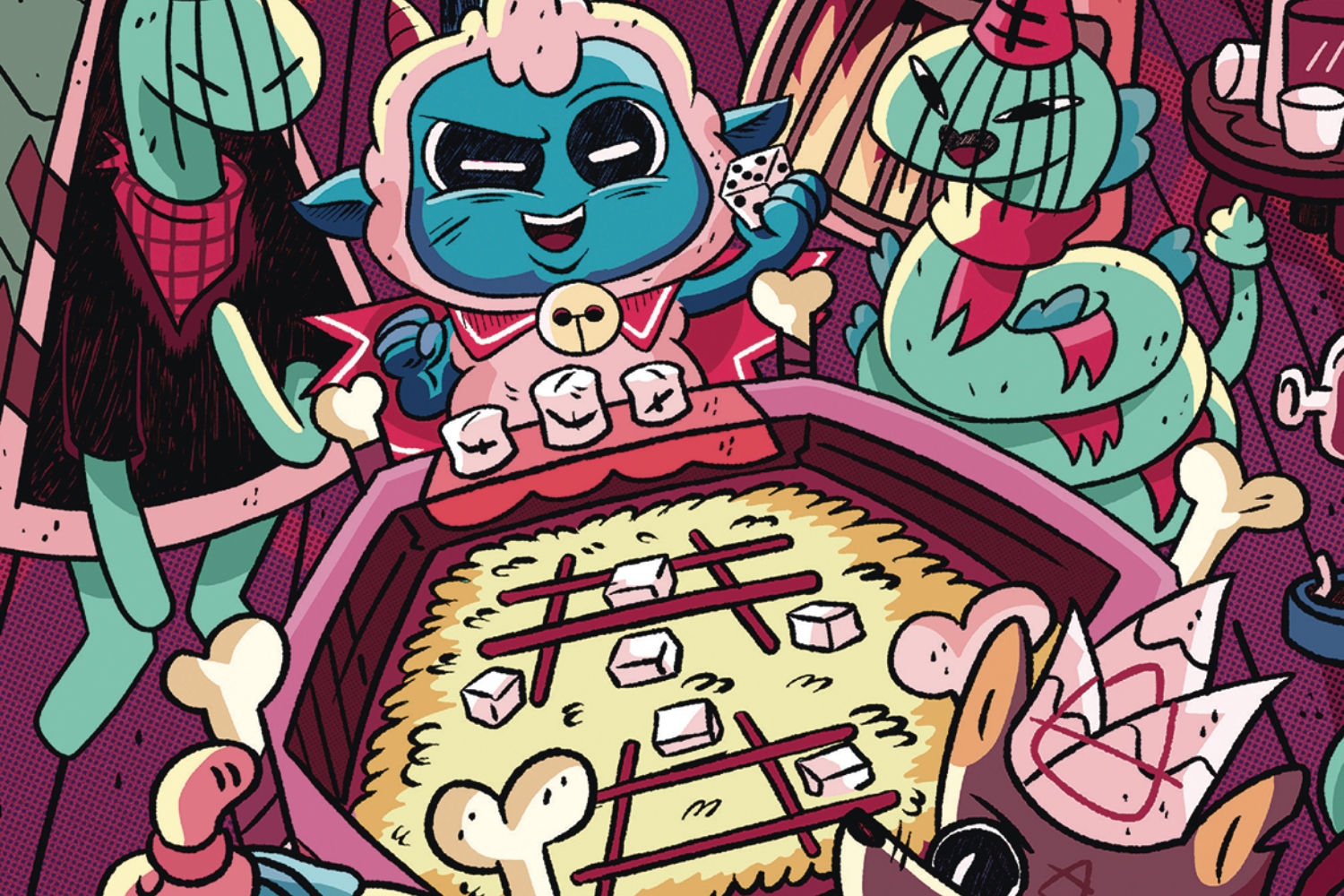

I think I’ve cracked the case surrounding Cult of the Lamb.
Not that there’s really been that big of a mystery so far — it’s just meant to be a comics adaptation of a beloved video game where you fight demons and sacrifice woodland creatures. But I think writer Alex Paknadel and artist Troy Little have approached Cult of the Lamb with a very specific framework that’s made it this emotionally resonant, wholly inventive slice of fantasy it’s been across issues #1 and #2.
And that’s because Cult of the Lamb is basically Conan.
Or, Kull or Solomon Kane or Bloodrik or really any rugged barbarian-type you’d rather imagine. Sure, Lamb is in a different kind of situation than those other brooding warriors, and there’s certainly a bit more focus on humor and absurdity to boot. But as issue #3 proves, Cult of the Lamb really is the best damn fantasy story this side of a Conan anthology.
It starts with some more “obvious” features. In issue #4, the lore of the world really solidifies in a way — it’s been pretty apparent and properly laid out thus far, but there’s an added framework about the Lamb being on a kind of hero’s journey that really coalesces across this chapter. And that’s helped via the dialogue in a truly massive way. There’s something about Paknadel’s tone and choice of words that just captures the magic and power of these kind of stoic barbarians battling foes and making their way through a harsh world. It’s these “little” things that prep the mind for some bigger decisions across this issue, and start to form and shape the story in our mind in such a subtle but effective way that Cult of the Lamb is really stepping up into this specific configuration.

Main cover by Carles Dalmau. Courtesy of Oni Press.
And while it’s maybe not as obvious (even as it’s still very much right there), the art also makes some vital decisions. So far, Little (alongside colorist Nick Filardi and letterer Crank!) have done a solid job in balancing the video game’s look and feel with twinges that make it their own. In this issue, there’s things that strategically and meaningfully extend that work. There’s even more great action scenes, and we can really feel the desperation and pain that Lamb goes through as their very mettle is tested in these confrontations. If that ain’t Conan-esque, then I don’t know what is.
Same goes for the interplay of light and shadow and generally the shading and line work here — it adds a greater sheen of intensity that really connects Cult of Lamb to the aforementioned, extra dramatic fantasy heroes. And, of course, there’s more monsters and old gods rolled out (including an extra nasty ghoul/fiend in Barbatos) that shows the depths of the lore and world-building in this series. They’re generally less obvious and also very much in line with the debut issues. But it just ups the intensity and drama of this chapter in a way that things feel all the more grand and epic (even as the cartoonish joy and aesthetic of Cult of the Lamb remains intact). It’s maybe not a turning point so much as it’s a solidifying of this book to become so much more than what it is already.

Incentive cover by Abigail Starling. Courtesy of Oni Press.
Similarly, there’s even more intellectual heft thrown around. I’ve noted in both of my previous reviews that Paknadel is really interested in fleshing out the core themes of this story — namely, what it means to be a real leader, community-building, and even ideas of economic inequality and social change. And that continues in issue #4, as Lamb really and truly sees the weight of being a leader and what that job really requires. (Spoiler: it ain’t just about swinging an axe real good.)
Similarly, Lamb is engaging with their followers in a way that’s both irksome (to Lamb) and also hugely important; it’s a way to drive home their real work and to humanize both Lamb and these followers around the sheer humanity of these larger concepts. And what would a hero be without his supporting cast, and in issue #4 both Lamb’s “lieutenants,” Nana and Ratau, have massive performances. It’s more than just that they’re both grounding Lamb and pushing them toward their true destiny — they also force Lamb to reconcile with the old and the new ways, and that battle may prove more satisfying than all the monster fights (maybe).

Variant cover by Troy Little. Courtesy of Oni Press.
Together, all of this drives home not only the stakes of this story, but grounds the theory and intellectual ponderings in this deeply human (cutesy animal?) framework. It’s not just ideas about resource allocation in a post-capitalist society, but we see hungry faces that really oblige us to engage even more overtly and passionately than before. Great fantasy stories have always done just that — peep this neat little essay — and Cult of the Lamb adds to the tradition of socio-political exploration with gusto and commitment.
Of course, I totally welcome the idea that my “theory” about Cult of the Lamb may be way off or even too obvious to have even been mentioned. But it seems important to note as this story continues to find new and inventive ways to give us ample bloody action and readily augment that with lots of humanity and intellectual heft. It’s my way of explaining this book’s true magic and prowess, and how it continues to excel at its mission and make something that’s both a little fan-service-y in nature and still wholly novel and important.
I can’t wait to see what’s next for Lamb and the whole crew — it’s a story that’s as big and muscular as Arnold Schwarzenegger in Conan the Destroyer.




You must be logged in to post a comment Login