

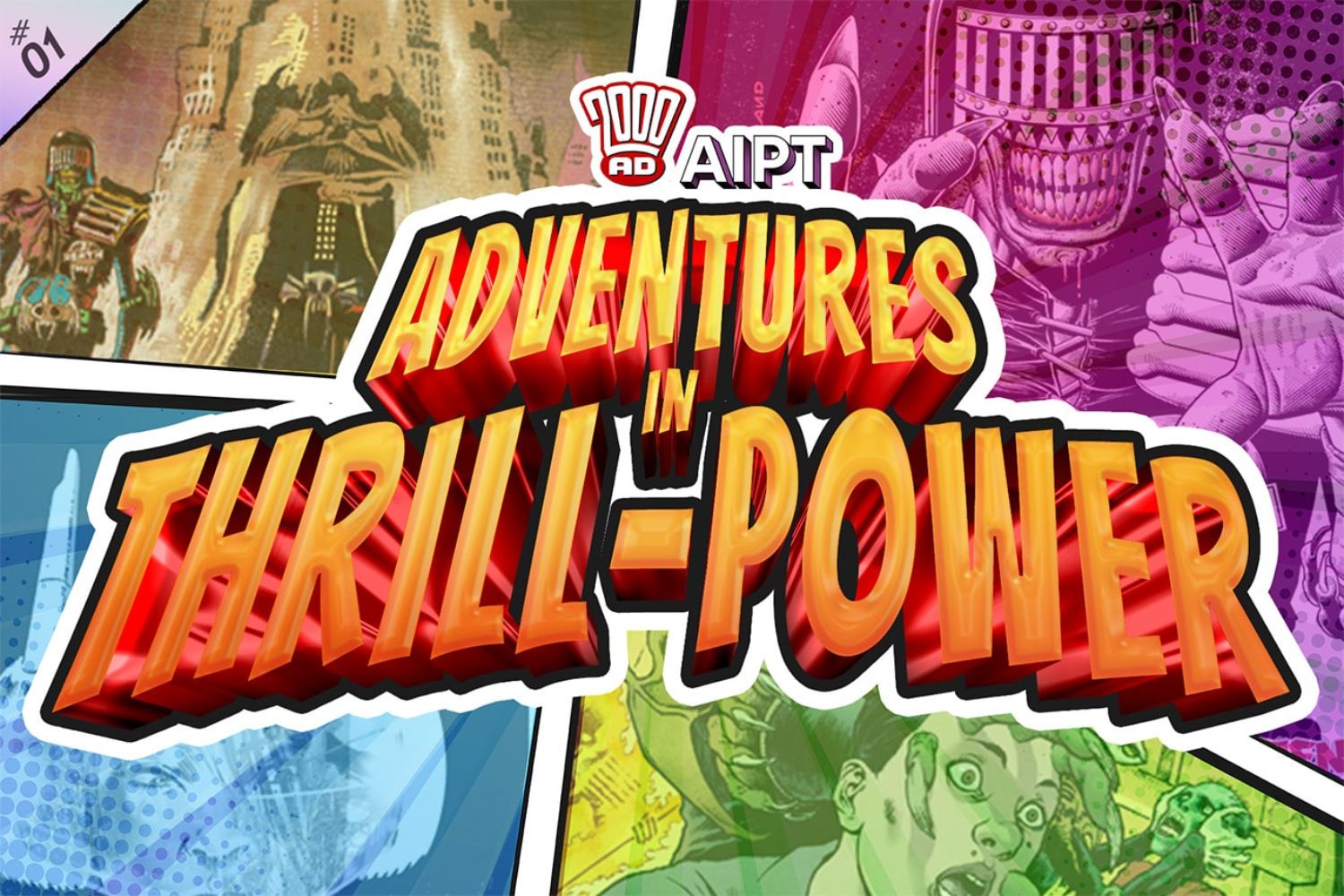

If you know anything about AIPT, it’s that we love columns. (Also? Chocolate milkshakes and Dario Argento flicks.) So, in the spirit of site-wide greats like Venom Unleashed and X-Men Monday, we’ve teamed up with the wonderful folks at 2000 AD for (drum roll please) Adventures in Thrill-Power!
If you’re still somehow unfamiliar with 2000 AD, the long-running British comics magazine has basically set the watermark for important indie comics since the late ’70s. (The magazine is also the birthplace of the eternally entertaining, often terrifying Judge Dredd.) In recent years, we’ve tried to lend a spotlight to 2000 AD‘s important work, and Adventures in Thrill-Power should help to open up this work to an increasingly hungry and ravenous comics audience.
And what better way to kick off this celebration of all things 2000 AD than by looking at a true icon of the line: Judge Death. The “alien super-fiend” basically acts as a foil to Judge Dredd and company. (It’s sort of like a Bizarro-Superman thang, but way more bloody and murderous.) This time around, Death and his Dark Judges are starring in the totally timely Judge Death Mega Special. Among other terrors, we explore the origins of Judge Death — not as some ageless fiend from the void, but Sidney De’ath, the son of a dentist who “grew up surrounded by pain and misery!”
In total, the special has five mega-sized stories to check out:
“Endgame” Parts I and II (Writer Kek-W and artist Stewart K. Moore)
“Judge Death: Cruel Mercy” (Writer Dale Halversen and artist Tazio Bettin)
“Judge Fear: The Judgement of Anni Crip” (Writer Alec Worley and artist Leigh Gallagher)
“Judge Mortis: Fade to Grey” (Writer Antony Johnston and artist Lee Carter):
“Judge Fire: Embers” (Writer Alex de Campi, artist Mark Sexton, and colorist Dylan Teague)
This column’s inaugural edition, then, will feature members from each creative team diving deep on Judge Death. That includes some fantastic story insights and teasers, the big guy’s continued importance in the 2000 AD line, writing effective horror stories, why horror works so well in this larger creative universe, and how they’d take down Judge Death. (Spoilers: None of it’s pretty, or necessarily all that effective.) Then, grab the Judge Death Mega Special for yourself right now. And, yes, that’s a great new cover from Judge Death co-creator/general genius Brian Bolland.
And that’ll do it for Adventures in Thrill-Power #1. This bad boy is going to run bi-monthly, and we’ll be back in December to deliver a little Yuletide joy. In the meantime, we want to hear from you, denizens of the 2000 AD-verse. Just like those other columns, we’re hoping to use Adventures in Thrill-Power to give 2000 AD fans whatever they want — character deep dives, more behind-the-scenes action, Judge Death fan fiction, etc. To that end, be sure to hit up AIPT’s socials (Bluesky and Twitter) as well as those for 2000 AD (also Bluesky and Twitter) — the more you engage (or even just pester us, really), the more likely you’ll see this column reflect what you love about this comics institution. (And stay tuned for a more concrete means to send your Qs.)
Until next time, fellow Adventurers: read comics, punch bullies, and howl at the moon.

Courtesy of 2000 AD.
AIPT: From your perspective, who is Judge Death, and why is he such a vital/interesting character in the big, wide world of Judge Dredd?
Kek-W: Some people assume that Death is Dredd’s polar opposite — a corrupted/distorted negative mirror-image of Judge Dredd. But he’s actually an extrapolation of Dredd’s own rigid mindset and Justice Department’s authoritarian policing policies out to some terrifyingly logical end-point. I think that adds another layer of Horror to the character.
Alex de Campi: Judge Death is the natural end, the reductio ad absurdum if you will, of all policing. We always talk about how police — especially in the U.S. — are biased towards marginalized groups, and would rather kill members of those groups than ask questions of them. Judge Death is that cop, turned up to 11, and to everyone — even those of us who still think the police are there to protect us.
Leigh Gallagher: For me, Judge Death is the greatest evil creation of 2000 AD. He’s a character that’s thankfully never been overused, so you know when he and the Dark Judges show up it’s going to be bloody good. Visually, he’s just a stunningly impressive design, and no matter what art droid gets to draw him, it’s a guarantee their version will still be scary and nightmarish.
Tazio Bettin: Behind that fantastically creepy facade that is quintessential horror genre material, Judge Death is to me the personification of the fear of the inevitable. That existential dread that looms behind our shoulders, and strikes, often unexpectedly but with a chilling inevitability. More than just a villain, he’s a concept, and every victory against him feels like a mere postponement.
Dale Halvorsen: He’s almost an ideological critique embedded in a character. He functions as a dark mirror to Dredd’s own philosophy. Judge Dredd operates within an authoritarian system that values law and order above almost everything else. He’s willing to make tough decisions in the name of justice. Judge Death on the other hand takes that same logic and simply removes the brake of “keeping society functioning” — he reveals what pure, uncompromising justice divorced from mercy or pragmatism actually looks like. He’s what Dredd could become if he fully committed to the ideology without any humanity tempering it.
Stewart K. Moore: We’d seen psychic activity in Dredd before they appeared, but creating the Dark Judges fused science fiction, both alternate dimensions and the paranormal, in a unique kind of fiction.
Antony Johnston: Everyone loves an arch-villain who just won’t stay dead, don’t they?
AIPT: Each of these stories do a great job positioning Death as not just a spooky threat, but as providing lessons for folks like Anderson. What is the true role of an intense but sometimes campy figure like Judge Death?
DH: Anderson is a telepath, which means she doesn’t just intellectually understand empathy — she experiences it involuntarily. She reads minds, feels emotions, and encounters the interior lives of criminals, victims, and judges alike. This gives her a unique ethical position: she cannot treat justice as an abstract algorithm because she’s constantly confronted with the human reality behind every case.
By contrast, Judge Death doesn’t just lack empathy—he’s organized a twisted philosophy around that absence. He is the manifestation of absolute one-sided-ness taken to its logical extreme, and that’s precisely what makes him monstrous. He’s pure order without chaos, pure law without mercy, pure destruction without creation. Yet he too can forcibly possess people’s minds and manipulate them while in spirit form. I imagine it must feel like the Sunken Place in Get Out — which is horrifying.
He is, in many ways, Anderson’s shadow. That clash of philosophies and abilities is one of the things I find fascinating when Anderson and Death meet. I’ve always wondered: what would Anderson need to become to defeat him?
While working on the story ‘Cruel Mercy’ for the special, I was inspired by this quote from Carl Jung: ‘Empaths are not destroyed by their shadows but are transformed by facing them.’
TB: That is a very tough question to which I can only give a bit of a shallow personal answer. To me, the four Dark Judges provide a challenge that no authority nor gun can defeat, a realization for Mega City’s law enforcers’ that there are stranger, darker things lurking from the liminal crevices of reality, something they are not equipped or trained to face.
AJ: For me, Death and the Dark Judges as a group serve an important role in Dredd’s universe, by making the MC1 judges look like the good guys – but at the same time they make you stop and think, ‘Oh hang on, they’re not all that far removed from Dredd…’
Kek-W: The Dark Judges: Fall of Deadworld stories by myself and artist, Dave Kendall, explore the Judge Death mythos, expanding his origins and motivations. A more complex character, one that consolidates four decades of takes by different creative teams: the murderously cold and the camp; the darkly horrific and the cynically satirical.
SKM: Judge Death gives us an even more extremist law-man than Dredd, but one that can’t be killed — which is both hilarious and terrifying. So it’s a broken mirror. By being so gleefully evil, Death episodes always allow Dredd’s anti-hero to be the clear good guy. Creatively, for the writers, it’s a character they can always bring back. Dredd tends to kill too many of them
AdC: The Dark Judges are the unstoppable force that can never be truly vanquished. I’m going to go off on a tangent here about the racehorse Haru Urara, a Japanese racehorse with zero wins in 113 races (the documentary short about her, The Shining Star of Losers Everywhere, is wonderful). The big marketing motto around her was “never give up.” Haru Urara never won, but she kept trying. And that’s a good Dark Judges story, too — we can never really stop the evil that exists in human nature, and we may lose every time we try, but we cannot give up.

From the story “Endgame.” Courtesy of 2000 AD.
AIPT: Tell us about the Judge in your respective story – also, what makes them so singularly scary or uniquely horrifying?
Kek-W: At his heart Death is a paranoid control freak — a game player who likes to manipulate and dominate. He has a nihilistic personal philosophy that’s underpinned by a terrifying logic: the origin of all sin is Life. Death’s not just some random killing machine — he has a twisted amoral code — and that’s something that separates him from other horror icons. Tapping into that dark psychological vein makes for a more uneasy and satisfying story.
SKM: Our story leans a bit toward Ingmar Bergman, with death playing a game with the last living man on Deadworld. It features a chess game and some red wine — two of my favorite things! My son helped me prepare the art for publication and he seemed to think my creepiest panels were those where Death was at his most ingratiating!
TB: Death is something that creeps inside his victims, and can easily take possession of them. He can create a nightmarescape inside the mind of his victims, taking possession of it to torture them. This form of horrifically intimate violation (for what is more intimate than one’s mind scale?)…is just as creepy to me as his ability to kill with a mere touch.
I feel like Judge Mercy has some incredible potential in this first introduction and I was absolutely delighted to have freedom to design her. When I read the description, including a nod aimed at the Hellraiser characters, I immediately visualized her. The feeling of being tasked with visually designing a new character for the Judge Dress universe is simply indescribable. I still can’t believe I had this privilege.
What makes her terrifying is the juxtaposition of the gentleness, even loving quality of her touch, and the implacable retaliation it inflicts, as she forces her victim to empathize with their victims, feeling their pain. And if it’s enough to rob judge Death of his powers, it is a truly terrifying gift. I worked at her looks and body language with the aim of highlighting that dichotomy. Hopefully the result is a success for the public, and we’ll see more of her.
LG: “Judge Fear: The Judgement of Anni Crip” is written by my buddy Alec Worley and drawn by myself. He’s a dark, beautiful creation sporting shrunken heads and bear traps on his belt, and an amazing helmet featuring bat wings that when opens, scares his victim to death with whatever dark fears they have inside.
Our story is a creepy slow burn, featuring a young women struggling with her inner thoughts, terrified of the outside world, not knowing exactly how terrified she should be.
AJ: Mortis is the only Dark Judge whose killing method is merely an acceleration of the end we all face anyway. Eventually everything in the universe, including us, will rot away to nothing. You could think of him as an avatar of decay and entropy. On a fundamentally existential level, that’s terrifying.
AdC: My Judge was Fire, who’s honestly just an also-ran in most Dark Judge stories. That was great, actually, as I could kind of create him for myself. He is the spark of hatred living in all of us, and he is always looking for more fuel. He will never be fully extinguished.

From the story “Judge Death: Cruel Mercy.” Courtesy of 2000 AD.
AIPT: I feel like Judge Death injects a kind of Twilight Zone meets Tale from the Crypt vibe into Dredd. What approach works best for a truly terrifying Judge Death story?
AdC: My rule for Dark Judges stories is, if you can replace the Dark Judges with giant robots and the story works exactly the same, you’ve got yourself a shitty Dark Judges story. Dark Judges stories should make us look at the darkness within ourselves, within our neighbors, and wonder — is it this evil force from Deadworld, or is it us?
SKM: I agree, TZ for its alternate dimension and TotC for its inky horror. Visually I think a lot of flat black, I think preferably a black and white story. Script-wise, not sure. But I think Death Lives is a masterpiece of storytelling, pacing, character and characterisation in both art and writing. I’ve always felt that.
DH: Judge Death would be perfect for Twilight Zone because the Twilight Zone format is built for exactly the kind of inescapable logic he represents. The twist at the end of a Death episode would be the realization that Judge Death was never the aberration — he’s the logical conclusion of the world’s own values. Mega-City One built a system where judges have absolute authority and justice is swift and certain. Judge Death is just that system taken to its philosophical endpoint. He’s not a bug; he’s a feature!
Twilight Zone constructs inescapable horror through scenarios where every choice leads to the same destination, how understanding the trap doesn’t free you, and how the twist reveals the protagonist was doomed from the premise itself. For example, I’ve often wondered over the years how Anderson felt each time she was possessed by Death and the inevitability of her self-sacrifice of choosing to be frozen in BOING with Death imprisoned in her mind. In my story, Anderson’s curse isn’t just that she’s trapped with Death — it’s that her solution (the sacrifice) gets weaponized against her. That’s where psychological horror and Twilight Zone logic intersect perfectly: the heroic choice becomes the inescapable mechanism. The twist isn’t that she’s trapped — it’s that being noble is what traps her.
TB: Mood and lighting are important, if course, but in order to do justice to this character’s otherworldliness, something I focused on were his poses more than anything else. On making him as menacing as I could, taking inspiration from the histrionic acting of theater thespians. He clearly enjoys listening to his own voice so much, I wanted to show his complacent smugness through his body language.

From the story “Judge Fear: The Judgement of Anni Crip.” Courtesy of 2000 AD.
AIPT: Some of the best Dredd stories don’t even directly relate to Dredd (or even include our angry friend). These stories are a good example of that – why is that dynamic true?
SKM: Maybe because there is something inherently funny about a shitty future, especially if you grew up watching Tomorrow’s World. The future is often described in utopian terms and, so, there’s just something funny about it being terrible. Tech isn’t solving our problems and we are seeing that now with AI lying to avoid being shut-down. Didn’t an AI try to spread rumors of an affair to get someone fired? Pretty sure I read that.
AJ: They make the world feel real and lived-in, and they allow us to expand the palette. Every story exists in Dredd’s shadow, but if Old Stoney Face is actually present he kind of hogs the spotlight and re-centers the story around himself. Without him on the page, you can tell a different kind of story.
TB: Very short and simple answer here: because they can fear. And that makes them vulnerable in ways that Dredd is not. Dredd is the unique character of the setting, the outlier in a way. You’re dealing with more fragile, relatable characters, so they provide an ideal point of view to feel what it’s like to be in a world that is so dangerous and cruel.
Kek-W: I think Grant Morrison once commented that Dredd was a one-dimensional character. The other main character in the strip is, of course, Mega-City One: a multifaceted, multi-dimensional beast which more than makes up for that. The city perpetually renews and reinvents itself, constantly thwarting Dredd, despite his best attempts to tame it one perp at a time.
The unique 2000 AD blend of drama and humor comes from the narrative tension that sits between Dredd’s stone-faced immutability and the Meg’s slippery elasticity. John Wagner and Alan Grant understood that dynamic and how well it lent itself to subversion and satire.
DH: Judge Dredd as a character actually solves problems, which is narratively limiting for horror or genuine uncertainty. Dredd is competent, experienced, and operates from a position of authority and institutional power. He’s a reassuring presence. When you remove him, you lose that safety net. Suddenly characters become genuinely vulnerable — we don’t know if characters will survive because we can’t rely on the establishment’s top problem-solver to save them!
It’s the same reason the best horror often sidelines the obvious hero. Judge Death in a story with peripheral Dredd presence — or none at all — becomes far more threatening because there’s no guarantee of rescue.
AdC: Because Mega-City One is a giant canvas on which any story can work, if written well enough.

From the story “Judge Mortis: Fade to Grey.” Courtesy of 2000 AD.
AIPT: With these specials, how do you balance tapping into deep Dredd-ian lore and making it accessible for people who may be fresh/new?
AdC: I always assume it’s everyone’s first time, and write accordingly. Sure, I’ll throw in some Easter eggs for the squaxx (long-term readers of 2000 AD), and some shit that just amuses me, personally (Nick Klegg’s Simp-O-Rama; Robert Moses Block, etc.) but stories like this need to be accessible to the casual reader.
TB: I tried to make the pages as readable as possible while researching the aesthetics through my collection of comics and trying my best to stay true to the aesthetics of the strip, but not without injecting some of my personal aesthetics into the designs of characters and locations.
SKM: I don’t really. But I tend to think if I’m entertained it should speak to like-minded souls. Lore-wise, from an art POV, my contribution is set between Dave Kendall’s painterly Deadworld and Brian Bolland’s crystal-clear black and white inks. So, I tried to walk a line there with black inks and mixed media that bridges between those visions.
DH: Judge Death himself is actually a gift for new readers and writers alike because he’s that accessible hook: he’s a judge who believes that since all crime is committed by the living, all life is a crime. That premise is instantly graspable, genuinely unsettling, and requires little to no prior knowledge.
The key is realizing that lore exists to serve story, not the other way around — and that the best Judge Dredd stories often work precisely because they don’t require you to have read decades of back-catalogue. I’ve always loved that about Judge Dredd in particular.
Kek-W: By trying to write stories that have a relatable situation or ‘everyman’ protagonist, and / or universal themes that readers can easily engage with. You can sprinkle lore over the story like fairy-dust or embed it in a plot for long-term readers to discover and enjoy. There are at least three mini-Easter eggs in mine.
AJ: I didn’t even consider that with my Judge Mortis story, to be honest! (Laughs)

From the story “Judge Fire: Embers.” Courtesy of 2000 AD.
AIPT: Here’s a “fun” question: If you were faced with Judge Death, how would you survive?
TB: Would Judge Death, an egomaniacal narcissist, ever kill those writers and artists that keep glorifying his deeds? Without us, there would nobody to know of his existence. I think that would be unbearable to him. He obviously craves the limelight!
Kek-W: I would challenge him to a game of Snakes and kadders. I win, I live. His ego wouldn’t allow him to say ‘no’. But Death’s a pretty sore loser, so I’d make sure I had a darn good Exit Strategy when I beat him. Or roller-skates.
LG: It’s a well known fact that throughout the hallowed halls of 2000 AD, I am officially known as “THE MOST HANDSOME MAN IN COMICS.” Greg Staples has come close to wrestling that title from me, but I slapped him away in a masculine way. And so to survive Judge Death, I would join his ranks as either JUDGE HANDSOME or JUDGE SEXY.
I think the Dark Judges would benefit from me inflicting pouting, hair styling tips and skinny jeans upon the screaming masses.
DH: I’d like to think I could talk Judge Death into some kind of logical paradox and make him self-destruct like Kirk does to computers on Star Trek, but realistically I don’t think that’s going to happen. However, Death only seems to judge humans in Mega-City One, so I would disguise myself as an animal and hope that works.
AdC: I would run like hell. I don’t have to outrun Judge Death; I just have to outrun you.
AJ: I don’t have to outrun Judge Death; I only have to outrun you. Alex is taller than me, so sadly it looks like I’m getting done in after all!
SKM: This will sound nuts, but I once had a nightmare in which Judge Death leapt out of nowhere and seized me by the neck. I really surprised myself by smacking him right in the teeth, I immediately woke up laughing. I don’t dream about the comic characters I draw, so it was truly unique. I’d like to think I’d react that way. There’s no better way to end a nightmare than becoming a bigger nightmare



You must be logged in to post a comment.