


When Simon Spurrier and Matías Bergara first teamed up on Coda, they created one of modern comics’ most inventive fantasy worlds. A few years later, they followed it with the nearly wordless masterpiece Step by Bloody Step, proving they could tell emotionally potent stories while stripping comics down to their absolute visual essentials.
With A Mischief of Magpies (out this week from DSTLRY), they’re heading in the opposite direction.
Rather than removing words, Spurrier and Bergara are using all the storytelling tools comics they have available. Diary entries, handwritten notes, prose passages, unconventional layouts, expressive lettering, and breathtaking fantasy artwork all flow together into a single narrative that feels unlike anything currently on shelves. The goal was never experimentation for the sake of it. Instead, every creative choice exists to bring readers closer to protagonist Marinus, a teenager who periodically slips into an impossible world known as the Wandering City.

Courtesy of DSLTRY.
For Spurrier, the project began with a distinct challenge.
“We asked ourselves what interesting experiments we could conduct with the comic book form,” Spurrier said. “Then the more important question became what story would actually justify those experiments.”
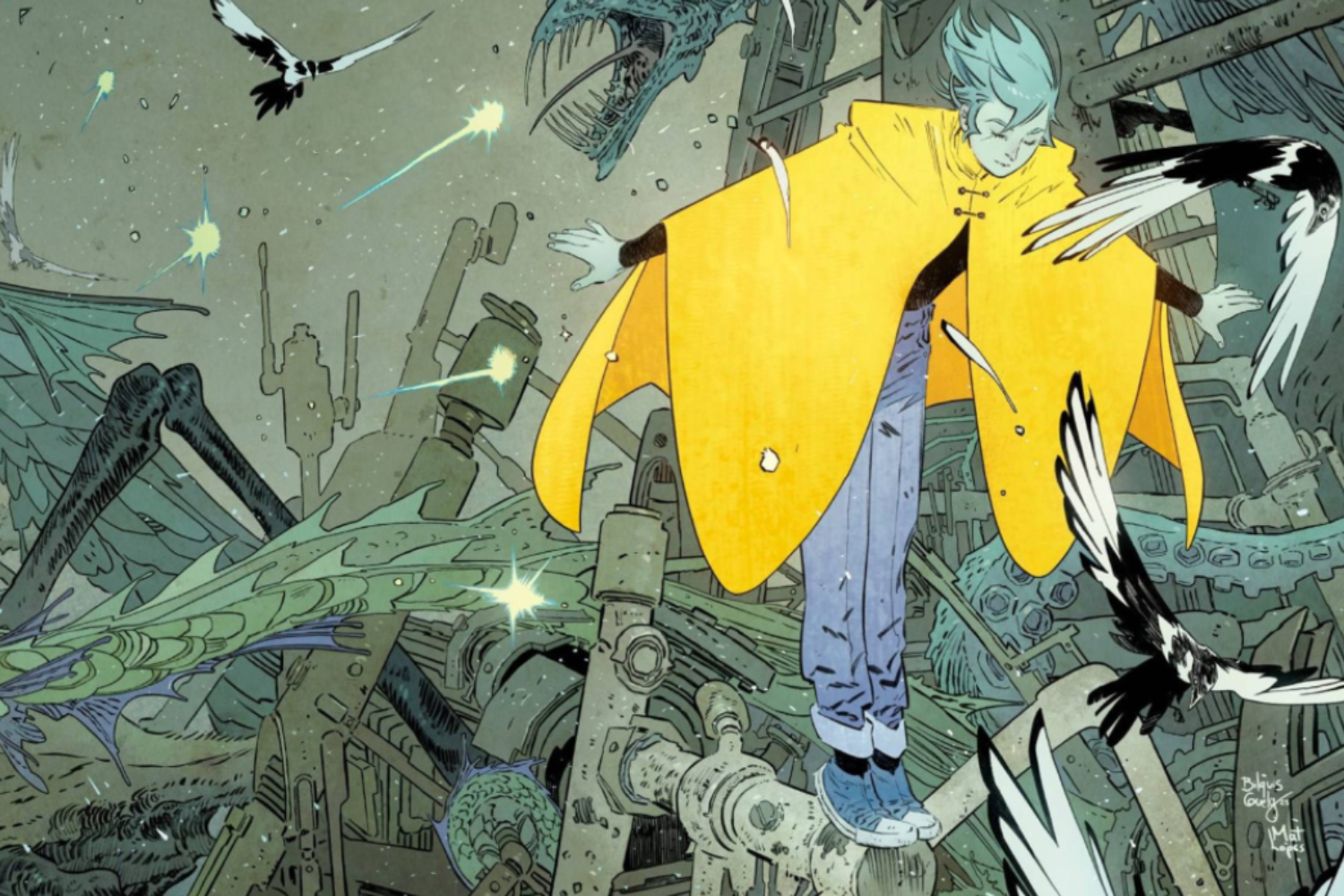
That answer became a portal fantasy split across two distinct realities. Mar’s ordinary life is presented largely through journals and written reflections, permitting readers to live inside his thoughts. His mysterious visits to the Wandering City explode onto the page through Bergara’s vivid artwork.
“The real world needs far less illustration because it’s something every reader already understands,” Spurrier said. “The fantasy realm is where Matías gets to unleash his imagination.”
The real challenge, of course, was making those transitions appear seamless.
“We wanted text and image to stop feeling like separate tools,” Spurrier said. “They’re all part of the same visual language.”

Courtesy of DSLTRY.
That philosophy even extends to Mar himself.
As readers move through his childhood into adolescence, even his handwriting evolves. Scribbles become sentences. Childlike sketches become more sophisticated observations. The page itself matures alongside him.
“It was a bit of both,” Bergara said of developing Mar’s visual voice. “Some pages required us to make formal decisions before we even knew exactly what words or images would appear. We were chasing emotional effects more than specific scenes.”
Spurrier compared the opening chapters to the tutorial level of a video game.
“You don’t want readers noticing you’re teaching them how to read the book differently,” Spurrier said. “By the time Mar reaches his teenage years, hopefully they’re completely comfortable moving between different forms of storytelling.”
The gradual introduction mirrors the creative process itself.
“We got to know Mar the same way readers do,” Spurrier said. “Different handwriting samples came from family members, including my own son. He slowly became a real person through all those borrowed personalities.”

Courtesy of DSLTRY.
If Mar is the emotional center of A Mischief of Magpies, then the Wandering City is undoubtedly its most fascinating character.
The massive city-machine sails across a shoreless ocean, divided into two dramatically different halves. Above the waves sits a gleaming civilization obsessed with perfection. Beneath lies a huge underworld filled with monsters, melancholy, and abandoned magic.
Spurrier intentionally avoided drowning readers in exposition.
“I knew it was a city divided between two opposite poles,” Spurrier said. “The people don’t think in terms of destinations. They simply go because that’s what they’ve always done.”
Bergara credits Spurrier’s scripts for providing just enough structure while leaving enormous room for interpretation.
“I don’t think everything needs to be explained,” Bergara said. “Sometimes color palettes or small visual cues communicate far more than pages of exposition. Some ideas need space before they explode later in the story.”


That philosophy further extended to Bergara’s astonishing environments. Every page rewards careful reading, packed with creatures, architecture, machinery, and tiny background details that make the world feel genuinely lived in.
“I love creating worlds readers can spend time inside,” Bergara said. “Little things like strange creatures hanging from rafters or unusual light fixtures may not affect the plot, but they make a fictional place feel alive.”
While the fantasy elements provide ample spectacle, Spurrier insists they were never intended to become an escape from reality. Issue #2 reveals that every trip to the Wandering City carries actual consequences in Mar’s real life.
“I think it’s irresponsible to present fantasy as a cure for reality,” Spurrier said. “Fantasy helps us understand ourselves, but it can’t replace living.”
That tension sits at the heart of Mar’s journey.
“He thinks he’s found somewhere incredible,” Spurrier said. “Then he realizes he can’t control when he goes there, and eventually the place he longs for becomes just as frightening as the life he’s trying to escape.”

Courtesy of DSLTRY.
Hovering between both worlds are the mysterious magpies themselves. They’re playful, profane, insightful, angry, and rarely offer straightforward answers. For Spurrier, they embody something so much deeper than comic relief.
“They live between extremes,” Spurrier said. “They’re creatures of compromise. They know exactly who they are, exactly what they want, and exactly what doesn’t deserve their attention. We could all learn something from magpies.”
Given the acclaim for Step by Bloody Step, comparisons were pretty much inevitable. Bergara welcomes them even as he views the two books as opposite creative exercises.
“With Step by Bloody Step, we removed language completely,” Bergara said. “Here we’re blending every form of language we can. The challenge wasn’t doing something bigger. It was making all those pieces feel like they belonged together.”
Spurrier believes that the challenge only succeeded because of the growing trust among the creative team.

Courtesy of DSLTRY.
Letterer Hassan Otsmane-Elhaou transforms dialogue into another visual element, and designer Emma Price was fundamental to merging prose, artwork, and layouts into something cohesive.
“If this book feels organic, Emma deserves enormous credit,” Spurrier said. “Every page passed through multiple hands over and over. That’s the real story behind A Mischief of Magpies. It’s what creative collaboration looks like.”
As experimental as A Mischief of Magpies may appear, Spurrier insists readers shouldn’t expect an elaborate puzzle box built solely around surprises.
“This is ultimately the story of a kid living through the hardest year of his life,” Spurrier said. “Every line, every panel, every image, each surprise exists to make readers feel what Mar feels.”
For a series built on shifting realities, magical cities, and impossible journeys, that emotional honesty may be the most extraordinary destination of all.
For more mind-busting fiction from Spurrier, check out another release from this week, Minotaur.



You must be logged in to post a comment.