

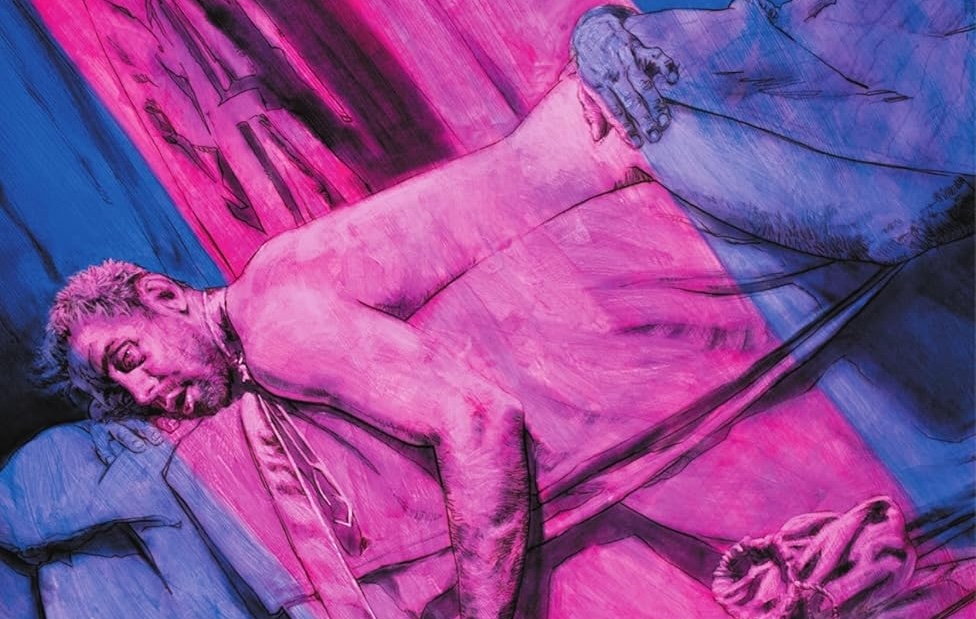

After conquering comic book storytelling last month, John Constantine, Hellblazer: Dead in America takes aim at stories inspired by Winchester Mystery House, the Bohemian Club, and the only American Myth that matters: The Phantom Traveler. However, reducing this book to a simple exploration of these American tales is a disservice to the yarn meticulously spun by the talented Si Spurrier. With each issue, Spurrier has deftly examined aspects of storytelling through exploring American mythology. The seventh issue of the series is no different.

DC Comics
“’Palimpsesting’, it’s called.”
Intelligent, funny, and beautifully illustrated, John Constantine, Hellblazer: Dead in America #7 demands multiple readings. By carefully rereading each page, the audience can write and rewrite their understanding of the story and its complex themes, which is the point of the entire issue. “Stories, myths – we keep what works and write over what doesn’t.” Only by keeping what works and writing over a previous understanding that didn’t, will the reader truly appreciate the creative team’s work on this title.
After reading this issue for the first time, my initial impression was that it felt like a thirty-one-page exposition dump. This is something that Constantine humorously calls out as Doctor Diablo dives deep into what he can recount from his autobiography. As someone familiar with Sandman, but not as well-versed as my colleagues, I remembered the broad strokes of the story but none of its nuances. As a result, a lot of the exposition felt familiar.
Despite this familiarity, Aaron Campbell’s haunting imagery drew me into the story as Elliot Garner retold his tale for the thousandth time. Campbell’s artwork perfectly captures the brutality of Garner’s atrocities while maintaining the narrative’s ethereal tone. Each panel is a horrifying work of art that only gets better with multiple views. Moreover, Bellaire’s colors perfectly capture the tone and demonstrate Garner’s ghostly predicament.
It was only after reading the issue for a second time that I realized I had missed Spurrier’s entire point: palimpsesting. As a result, I would need to rewrite my understanding of the narrative to change the meaning to something different. From this point forward, it was clear that this title was no mere exposition dump for those unfamiliar with Doctor Diablo.

DC Comics
“You can pretend all you like, love. You can mix up the stuff them three horrors with the things you’ve pretended to forget.”
John Constantine, Hellblazer: Dead in America #7 is Spurrier’s expertly crafted thesis on palimpsesting. By allowing this writing technique to subtly permeate every facet of the story, Spurrier has crafted a tale that demands reading. His humorous recontextualization of the “bangs” in the title’s stand-in for the Winchester Mystery House from gunshots to “a half-shredded myth and a pansexual zombie, bonkin’ like bunnies to avoid the heavy shit” left me laughing out loud. It serves as a perfect introductory example as to how this technique can change the meaning of a story to something opposite.
Additionally, the Kindly Ones rewriting Doctor Diablo into America’s interpretation of the Phantom Traveler is the perfect opportunity to use this technique to delve into Diablo’s backstory while also tackling the only American Myth that matters. Spurrier’s use of palimpsesting to explore each of these tales is absolute perfection. One of the things that I love about this issue is how the story of the Phantom Traveler plays out as a backdrop to the main narrative. Spurrier once again allows palimpsesting to take center stage as he writes Diablo’s narrative on top of the Phantom Traveler’s.
The beauty of Spurrier’s work in John Constantine, Hellblazer: Dead in America #7 is in his subtlety. It wasn’t until the cab driver says, “All right, fellas, we’re here. And listen, I ain’t no eavesdropper, but y’all gotta be high, the crazy shit you been… uh… fellas?” that I knew what had happened. Instead of rehashing the story of the Phantom Traveler, Spurrier allows the character to play out the tale as a B-story to Elliot Garner’s narrative. It’s a clever stroke that left me with an “a-ha!” moment during my subsequent readings.
I would be remiss if I did not mention Spurrier allows this writing technique to permeate the plot as Doctor Diablo reveals that he used Dream’s sand to rewrite the American Dream. By spreading the sand and the Bohemian Club, Diablo was able to hobble the influence of its members. By allowing Bohemian Grove to become a breeding ground for conspiracy and myth, its members lost their power as the masses could blame those in power for their problems. Spurrier’s use of this writing technique perfectly ties the entirety of this issue together.
Intelligent, funny, and beautifully illustrated, John Constantine, Hellblazer: Dead in America #7 is a perfect examination of palimpsesting. Spurrier’s use of this technique to construct his narrative while allowing the villain to use it for nefarious deeds is absolute perfection. Additionally, Campbell’s artwork with Bellaire’s colors perfectly captures the brutality of Garner’s atrocities while maintaining the narrative’s ethereal tone. If you haven’t already, rewrite your actions to include a visit to your local comic shop and pick up this book. As for me, you’ll find me rereading this book. I’m sure I’ve missed something that might change its meaning.




You must be logged in to post a comment Login