

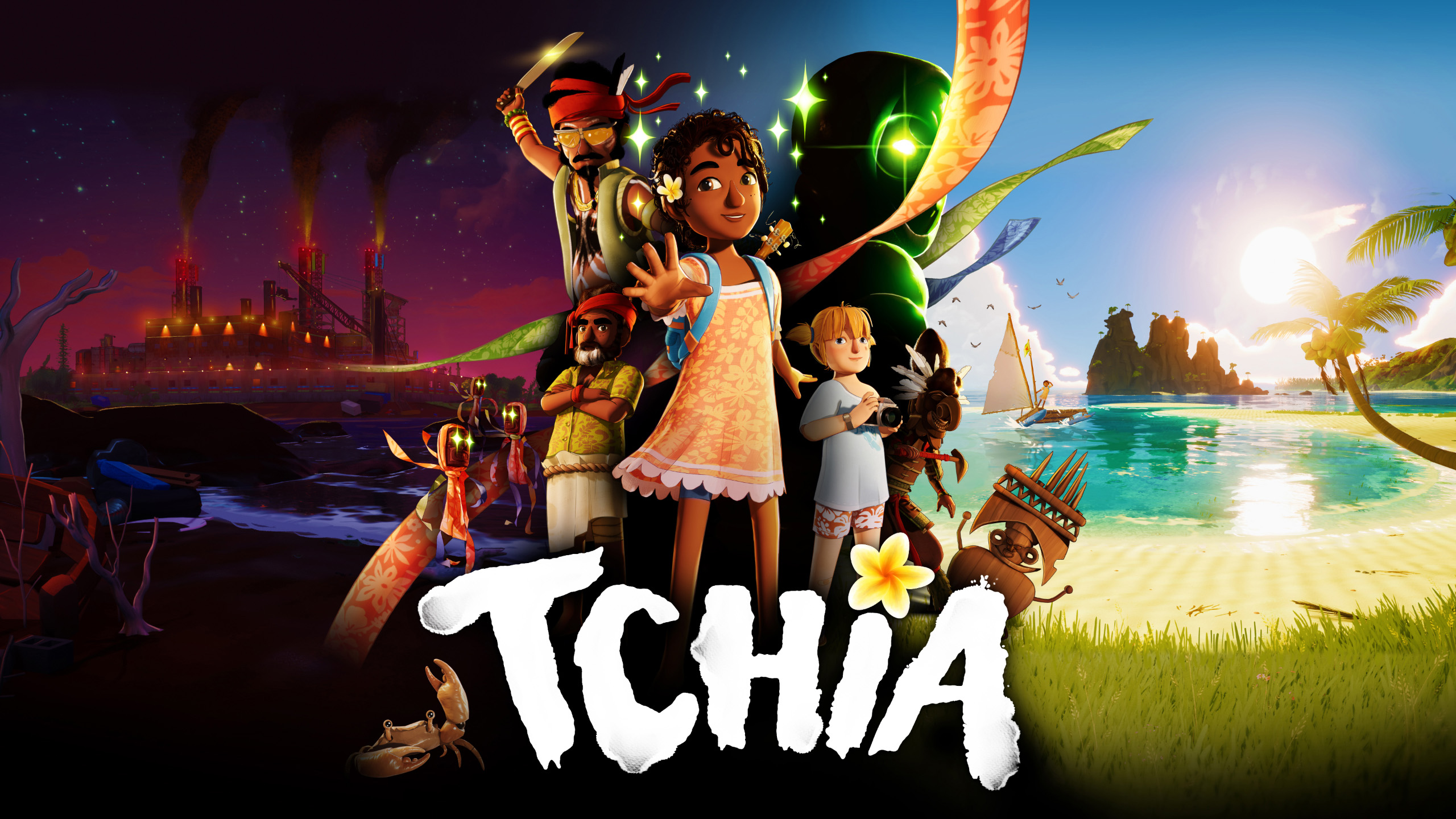

There’s a lot of promise and heart to Tchia. The game’s titular protagonist is bright, cheery, and instantly loveable. Its sense of humor is fantastic, spotlighting a sort of supernatural coming-of-age (while somehow also capitalizing on newborn-eating Big Bads and decapitated chicken gags). There’s a true sense of whimsy and joy at the game’s core that makes the player want to dive deep.
Pointedly marketed as being inspired by the culture of New Caledonia, a small island nation between Australia and Fiji, the game is at its best playing with the unique aspects of that culture. At one point, Tchia is whisked off to a small, bizarre island populated by the delightfully strange Mwaken, tribal woodcarvings possessed by spirits, and it’s all the player can do not to fall deeply in love with their goofy antics. In a cutscene, the Mwaken struggle to understand the various objects (camera, dead chicken, ukulele) in Tchia’s backpack. As she swims around, collecting the odds and ends about the island, she can bump into a Mwaken casually floating on its back in the ocean, enjoying the day.

Captured on Switch.
Throughout the game, a deep sense of folklore permeates Tchia’s actions and adventure. There are strange magics, spirit walks, babies being tossed into holes, and a mysterious, wooden-masked superbeing flying around on a hand-carved Goblin Glider. Tchia’s central power is to possess things herself, from the birds she needs to navigate the island distances to firewood she needs to burn baddies. Local flavor is (literally) fitted in: various food counters and campsites feature delicious-looking dishes of rice, fish, and steamed greens. Best of all is Tchia herself, who feels rambunctiously game for even the most dark, tragic aspects of her story. You want to best the villains with her; you want to wrap her up in a big hug.

Captured on Xbox.
If all this feels as if there’s a big “but” coming, that’s because there is: for all its delightful cultural novelty, Tchia is a game overburdened by frustrations. From the opening minutes, its seems unwilling to be played as it bombards you with a half dozen tiny, tedious cutscenes and tutorials for mini-games that might better have been discovered organically in exploration. There are few things more frustrating than being tantalizingly dropped into a game only to have the control immediately ripped from you two minutes later; to have that happen four to eight times in a row is all but game-ending.

That burden surpassed, inciting incident achieved, the player is put on a raft, given sailing instructions that aren’t made half as clear as any of the previous interactions (boring rhythm game songs included), and set loose on the world… until, woefully, they are not. Sent to one island, the game actually doesn’t begin until the player is forced to an entirely different island.
The discovery, immediately upon setting out, that Tchia is mostly a Breath of the Wild clone with a bit of sandbox Assassins Creed-style minigames thrown in, is so deeply disheartening that one might be tempted to call the whole thing off. The play-to-pain ratio of those minigames – unskippable and barely tolerable rock stacking (that unlock much needed magic songs) and near-impossible ukulele rhythm games for songs that English-speaking players cannot understand without quickly disappearing subtitles they can’t read while playing – is almost comically steep.

These frustrations are cut down in the Steam and Xbox versions of the game because the scenery is so delightful to look at: radiant, tropical sunsets and promising green mountain vistas loom on the horizon. In the Nintendo Switch version, the player is robbed of even the visual delight, the gradated washes of color on the sea are flattened down to flat primaries, the scenery in the distance a bland destination rather than a welcome invitation. The textures are condensed to meaninglessness, light and color are hazy at the edges, and the draw distance is abysmal, making certain game mechanics more chore than play.

Against all that gameplay frustration, the player is still drawn to continue. When you are prompted a few hours in to push ‘A’ for Tchia’s first kiss, the joy of the thing washes away all the preceding tedium of open world chore fatigue. That all of this was accomplished by a 12-person dev team is uncanny; the amount of heart and celebration they’ve poured into the game is overwhelming. Though that joy and celebration might not overshadow the Nintendo port’s baffling lack of beauty, it seems clear that everyone over at awaceb deserves just as much celebration and praise.
For all its frustrations, Tchia is a game that begs to be experienced. If you can just hold on long enough, you’re certain to fall in love.




You must be logged in to post a comment Login