

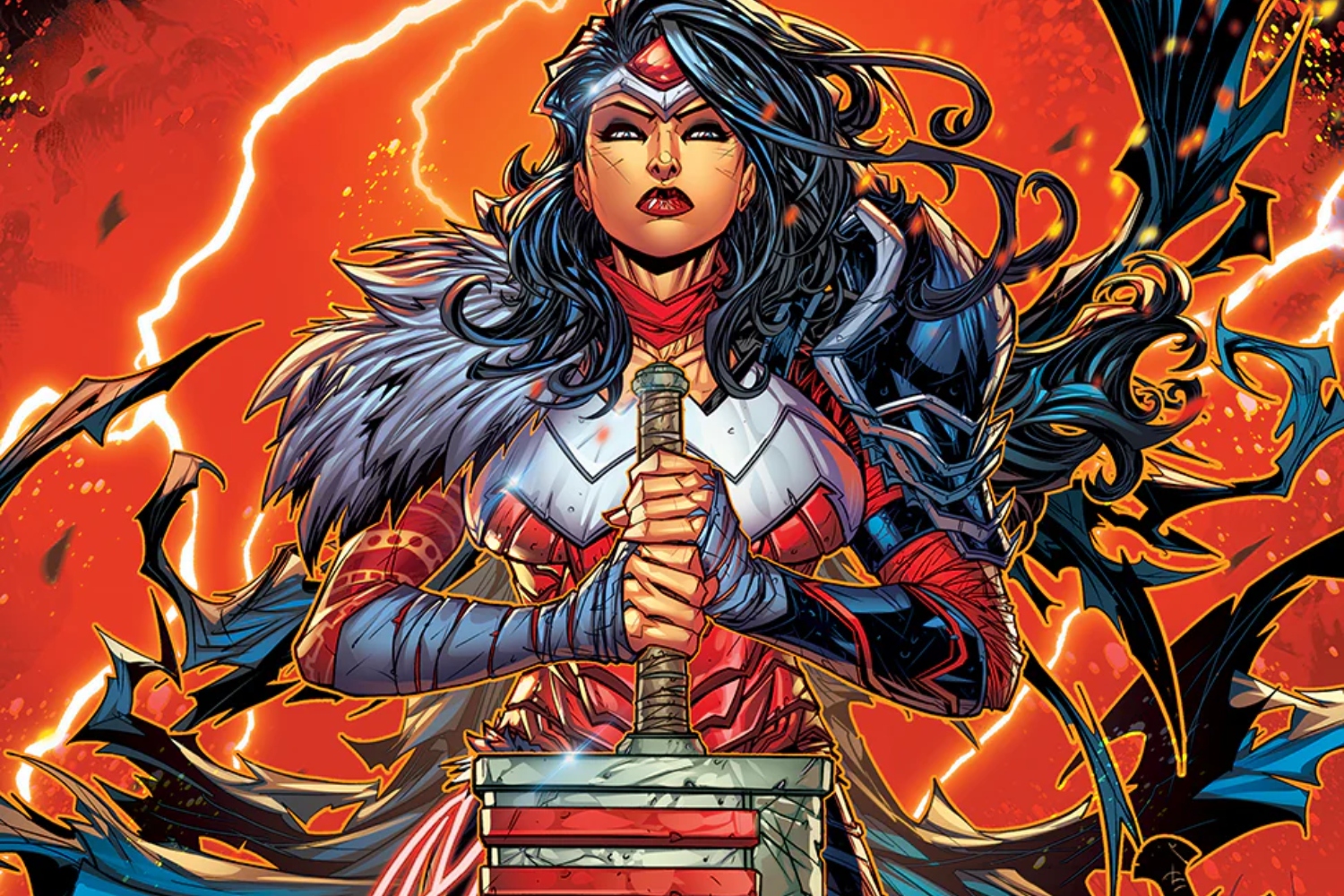

Wonder Woman as a concept has more integrity when feminist themes are centered. Her creator, William Moulton Marston, knew this, and subverted the Greek myth of Pygmalion in service of this truth. Radically for the time, Marston insisted on the self-possession, and interiority of female comic characters, as well as the idea that womanhood and femininity did not need to proceed from manhood and masculinity to have value. Unfortunately, under creators like George Perez, this theme was removed from the character’s work and she suffered because of those decisions.
In recent years two works have emerged which attempt to thematically right the ship: Kelly Sue DeConnick, Phil Jimenez, Gene Ha and Nicolla Scott’s Wonder Woman Historia: The Amazons (Historia) and Kelly Thompson and Hayden Sherman’s Absolute Wonder Woman.
The latter features an attempt to weave the storythread of the Pygmalion myth back into Wonder Woman’s story. It’s important that readers recognize both works as, even though they are not canon to each other, Thompson has said, “I drew from all of it.” in regards to Historia, and that “We stood on their shoulders to build this.”
If you haven’t already, be sure to read parts one and two.

From Absolute Wonder Woman #1. Courtesy of DC Comics.
Historia as DNA
Historia is the first of three planned books documenting the history of the amazons as a people group. It takes readers from just before the creation of the first amazons to the beginning of their exile on Themyscira. Here, DeConnick is playing with the same mythological-fantasy genre tropes that informed much of George Perez’s work, however, she is choosing to subvert them at every opportunity. In this way, when power is centralized in Historia it is for the express purpose of critiquing rather than merely affirming.
In the first issue, Zeus dismisses the goddesses’ concerns about male violence by expressing that men are a purpose unto themselves; they do not have to justify their existence. In contrast, in the same issue, Hippolyta is required as a midwife to “expose” an infant (i.e., commit infanticide) because they were born female. These moments combine to create an echo and a critique of the perspective presented in the original Pygmalion myth, that for women to exist they must proceed from the needs and desires of male power. Importantly, their critique also serves to echo the birth control movement which clearly influenced Marston.
The perspective that the Amazons, and Diana by extension, always exist to critique power informs the rest of both of these works. It’s also a perspective which is feminist in nature, and informed by stories of feminist struggle. For these women, their identity and freedom are claimed directly in spite of the gods. Even Diana’s name alludes to the freedom they steal for themselves, as she’s named for Artemis who offers the amazons their only reprieve from the tyranny of the male gods in Historia.

From Historia. Courtesy of DC Comics.
An Absolute Reframing
This reading of Historia should inform how readers understand the text of Absolute Wonder Woman. One of the dueling threads from the first issue focuses on presenting Marston’s inversion of the Pygmalion myth. While readers aren’t explicitly told how Diana is born, they do see her left with Circe from infancy. Circe then acts as Diana’s only caregiver, teacher, and companion for the time up until reader’s meet her — therefore, we can imagine her as Diana’s sculptor. This relationship establishes for Diana the practices which are acceptable for her as a woman in day to day life, and importantly a lack of boundaries on what is acceptable.
Like Marston, Thompson centers a mother in the narrative, though it’s Diana’s adoptive mother Circe. In an evolution of Marston’s efforts, Circe isn’t simply depicted as possessing an inner life, but one which is complex and possesses the capacity for larger change. Diana isn’t simply existing in a place which accepts and encourages interiority; she’s acting as an agent in that environment without considering permission. There’s a dynamic and believable reciprocality which informs the relationship between these two women, and it’s this reciprocal love which replaces Pygmalion’s maleness as the spark of life in Thompson’s narrative.
This dynamic allows Diana to discover her identity in an act of unity with her mother, instead of rebellious division. In Marston’s original narrative, Diana achieves her identity as Wonder Woman by deceiving her mother to achieve power. This is something which has been further developed under other authors, such as Perez.
The feud between queen and princess is one rooted in patriarchal contests for power, as the lie necessary for Diana to become Wonder Woman is inherently an attempt to wrest away control for herself. Rather, unity allows the narrative to deny male imposed divisions of feminine value, establish the appropriate object of one’s desire as wholeness as opposed to power, and facilitate the theme of truth to be centered in a crucial moment of the narrative.

From Absolute Wonder Woman #1. Courtesy of DC Comics.
In Historia, patriarchy’s explicit denial of feminine power is deliberately undercut by Hera herself. In her choice to help the goddesses and Hippolyta create Diana on Themyscira, there is an assertion that womanhood and femininity can rightly derive from a source which is “not-man,” as DeConnick puts it. Power is something which women possess. This is additionally undercutting other popular Wonder Woman works, Perez’s of course, but also Brian Azzarello’s and Grant Morrison’s works.
In another improvement upon Marston’s work, Thompson engages in a subtle refutation of the eugenicist politics which were present in Marston’s influences. She and Sherman are centering women who’ve been cast into hell with the implication that they are “undesirables,” which could be read as refuting the eugenicist classifications of different marginalized or underserved people groups in this way. Further, Diana’s depiction as a person with a disability, as readers discover in issue #3, and Circe’s depiction as a woman experiencing visions, as readers saw in issue #4, would likely have driven the eugenicists present in first-wave feminism mad.
In Absolute Wonder Woman, Thompson crafts a character in Diana who challenges the idea that it is exclusively men whose right it is to possess power, and that women’s possession of power is wrong and barbarous. Throughout the first few issues Diana and Circe are depicted as worshipping the goddess of witchcraft Hecate, who in the main DC continuity is commonly portrayed as a villain. This depiction originated with Perez who cast Hecate as villainous because she sought to remake the world which the Greek patriarchy had crafted in their image, thus her power as a female goddess was depicted as barbarous and wrong. In Thompson’s narrative, which positions Diana in opposition to the Greek patriarchy, the powers of Hecate take on new, more positive meanings.
The statement that “Love is transformative,” undergirds every show of power which Wonder Woman engages in. Thompson infuses the book with a recognition of the cost of violence and sacrifice, specifically in the book’s depiction of magic which Thompson wants readers to know, “has consequences.” This both further emphasizes the emotional commitment to justice which is necessary to continue, and works as a critique of patriarchal depictions of power which often don’t consider the consequences of power’s use.
This coding of power even goes so far as to directly dismiss two of the classic symbols of masculine power in issue #2. First, Thompson shows readers Steve Trevor admitting that his and Diana’s heights “don’t matter at all,” explicitly dismissing this symbol of masculine power. Then, later Thompson returns to this concept when Diana’s height intimidates Commander Cole, emphasizing how those who believe in patriarchal power subject themselves to that same power. Additionally, in a moment of levity, Diana describes Steve’s military uniform as a “very handsome costume.”
Thompson is sure to steer clear of the thematic dissonance of a nationalist Wonder Woman. In issue #2, Diana expresses to Commander Cole that “any efforts to fashion me into yet another arm of your military-industrial complex will simply not be tolerated.” At the same time, this underscores the feminine possession of power, which Thompson has asserted throughout the work. In issue #3, Diana tells the people of Gateway City, “Kindness and compassion are all that will save us now,”which explicitly recognizes the impotency of the military to preserve peace and safety for everyone.

Courtesy of DC Comics.
“Amazon. I’m an Amazon.”
In the end, Thompson has built on DeConnick and Marston’s work so that they’re all declaring, with their fullest of chests, the inherent worthiness of women as torchbearers of the human experience. Power, dignity, and interiority are all expectations for the female characters in Absolute Wonder Woman. In this, Thompson is penning her own strongly-worded refutation to the nonsense of the Pygmalion myth’s original author, and their modern, real-life counterparts.
This re-assertion that women are the author’s of their own womanhood and femininity is central to every other characteristic of Wonder Woman at her core. She has been built on this foundation since the 1940’s, and the character’s strongest and most important outings will always return to this foundation. It’s the reason Absolute Wonder Woman, with all its many changes, channels the spirit of Wonder Woman better than a mainline Wonder Woman title has in years.



You must be logged in to post a comment.