

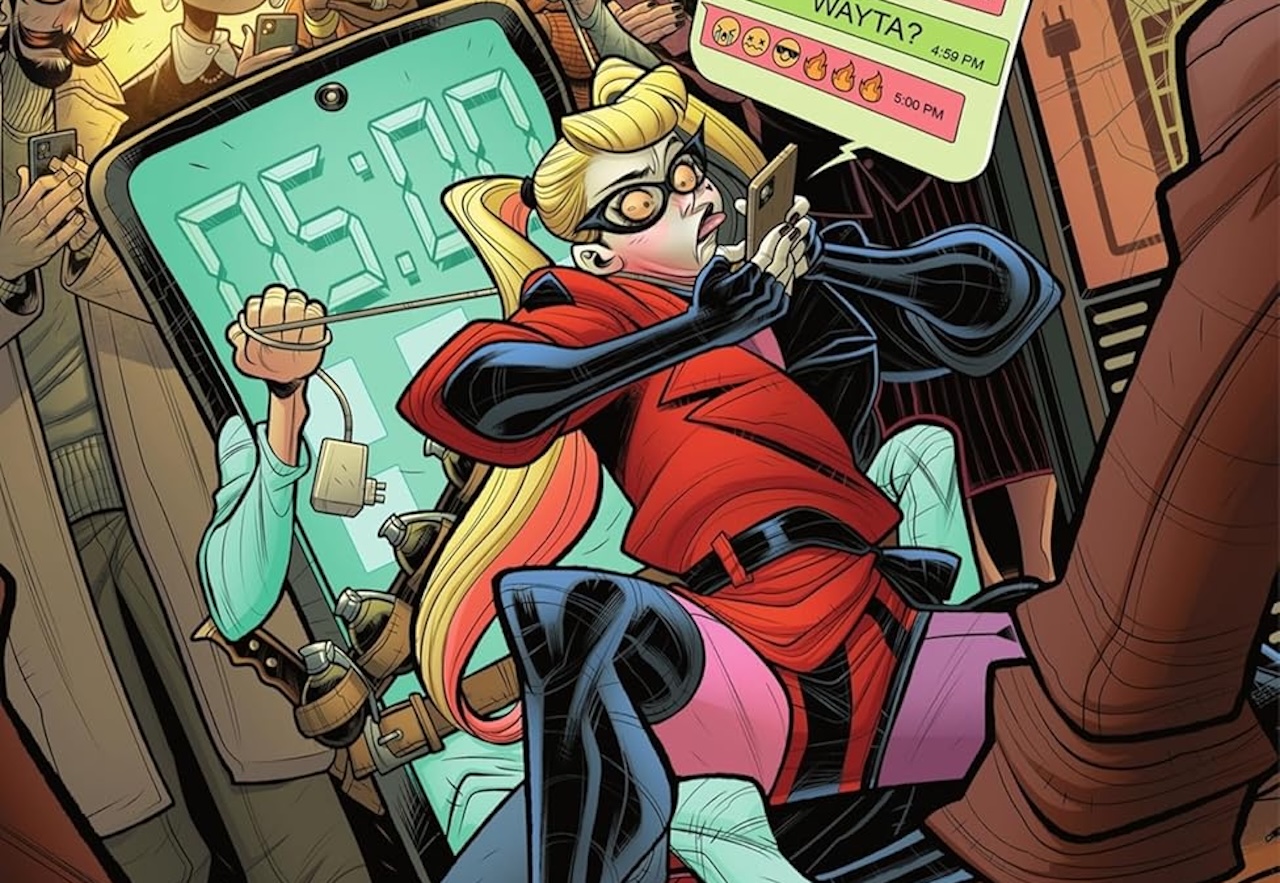

After the nefarious Althea Klang installs a phone charging station (aka hipster loiter magnet) right outside their home, Harley Quinn and Mrs. Grimaldi have only one option: use her trusty bat to smash the freaking thing to bits while listening to Still by Geto Boys. When Klang’s hired gun, Ravager, inevitably thwarts their half-baked plan, Harley and Mrs. Grimaldi decide to do the next best thing and take her to court. Unfortunately, the involvement of several concerned citizens and their differing opinions threaten Quinn’s protest of the “obstructive nuisance erection. “
“I can’t help it if municipal zoning terminology is objectively hilarious.”

DC Comics
Saturated with comedy and combat, Harley Quinn #52 is pure, unadulterated comic book junk food. Elliot Kalan’s Looney Tunes-inspired humor is addictive, leading you mindlessly flip from one page to the next. Mindy Lee’s artwork and Triona Farrell’s colors add to the narrative’s humor and cartoonish tone. Unfortunately, there’s little substance to leave you satisfied long after reading the book. There’s a message in here about politics and gentrification, yet it feels more like an afterthought than a through-line for the reader to follow. As a result, the titular characters’ Merry Melodies-fueled hijinks drown out the themes.
As our story begins, we find Harley presenting her opening remarks to the court regarding the newly installed phone charging station on her stoop. Throughout this entire sequence, Kalan does an excellent job of using Harley, Ravager, and Klang’s testimony to provide a humorous frame to the otherwise straightforward story and give it depth. One of the strongest aspects of Harley Quinn #52’s script is Elliot Kalan’s use of voice throughout each deposition. Kallan nails each character’s impersonation of the others, allowing each joke to pay off in a way that best reminds me of Bugs Bunny and Daffy Duck in the “Duck Season, Rabbit Season” bit.
Mindy Lee’s artwork adds fuel to the fire when comparing this episode of Looney Tunes. The cartoonish nature of the artist’s work makes it impossible not to draw comparisons between the two works, even if the styles are not necessarily similar. This comparison is amplified by Farrell’s use of early 2000s DCAU-inspired colors.
One of my favorite elements of Harley Quinn #52 is Lee’s use of emoji-styled faces to convey who is telling their part of the story during any given sequence. Not only does this alleviate any confusion as to who is speaking at any given time, but it also cleverly ties into the conflict. By using emojis of each character, Mindy Lee subtly provides a visual reminder of Harley’s reason for appearing in court.

DC Comics
“Whoa, whoa, whoa. This isn’t how it happened. At All.”
Unfortunately, the entire story does not tie as well together as Mindy Lee’s artwork with the overarching conflict. Although Chicken Fingers serves as the impetus for Quinn taking the issue to court, his eleventh-hour appearance before the judge feels more like an afterthought than a necessity for narrative cohesion. A large part of this disjointedness is due to the script not reinforcing that Harley Quinn’s actions are motivated by serving Chicken Fingers and other homeless individuals. It is mentioned offhand at one point during the beginning of the issue. However, the titular character’s reasoning is lost throughout the cacophony of Merry Melodies-inspired antics.
As a result, the theme of gentrification feels more like an afterthought than the driving force behind the issue. Additionally, Chicken Fingers’ plea to work together in politics feels tacked on because of his minimal role in the issue. By the end of the issue, I found myself wondering what the point of the story was. Like junk food, there is a lot of comedy to feast upon but not enough substance to leave you satisfied long after reading.
Overall, Harley Quinn #52 is pure, unadulterated comic book junk food. Elliot Kalan’s use of Looney Tunes-inspired humor is addictive like candy, leading you mindlessly turn from one page to the next. Mindy Lee’s artwork and Triona Farrell’s colors add to the narrative’s humor, cohesion, and cartoonish tone. Unfortunately, the lack of a clear thematic element leaves little substance to satiate the reader for long. Kalan’s message about politics and gentrification feels more like an afterthought than a through-line for the reader to follow. In the end, the Harley’s Merry Melodies-fueled hijinks drown out the message.




You must be logged in to post a comment.