


You might best know Meredith McClaren for 2023’s genuinely great Black Cloak series. Alongside writer Kelly Thompson, McClaren crafted a beguiling blend of neo-noir and sci-fi fantasy about two titular detective-types solving the murder of a slain prince. Now, McClaren is not only shifting gears genre-wise, but she’s going it completely solo as the writer-artist on a brand-new graphic novel, Meat Eaters.
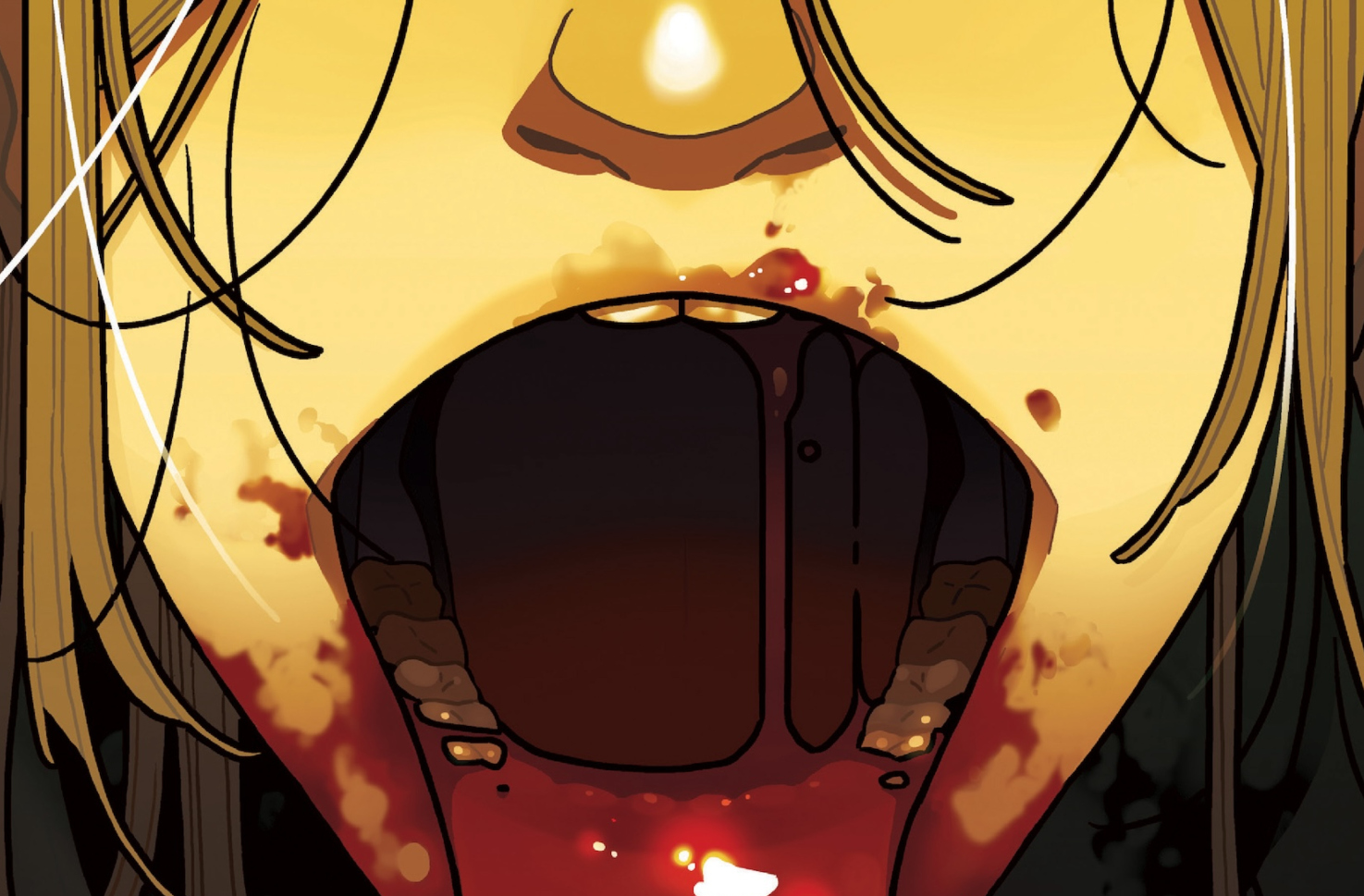
Published by Oni Press, Meat Eaters follows Ashley Moore as she tries to make it out of her small town before it swallows her whole. Only one day, Ashley encounters a teeny, tiny hitch in her plans: She’s suddenly undead, and now struggles with this undeniable lust for raw, bloody meat. As she tries to figure out how she died, and what it all might mean, Ashley finds herself “getting advice from ancient vampires, dodging angry pack leaders, and becoming the reluctant big sister to werewolves Motley and Harrison.”
Ultimately, dying may be the easiest thing Ashley’s ever done — the real work is breaking through the baggage as Meat Eaters explores “the effects of trauma and anxiety.” It may do so with ample gore and guts, but Meat Eaters is also a book for everyone regardless of their love/disdain for horror. It’s about how we all try and survive the seemingly worst thing we could ever imagine, and learn just what it takes to actually make it out the other side. You’ll be dying to read this, that’s for sure.
Meat Eaters is available beginning July 8. In the lead up, McClaren was kind enough to answer a few questions via email. That includes her horror faves/inspirations, working as both writer and artist, the utility of horror for all ages, the book’s ideas about growth/change, and some handy DIY advice.

Courtesy of Oni Press.
AIPT: They’re different books in several ways, but did you take something from Black Cloak into making Meat Eaters? Did BC give you the “courage” to do this book?
Meredith McClaren: Meat Eaters and Black Cloak actually started production around the same time in 2022. And Meat Eaters has been in my pitch pile since 2018, so both books would have occurred with or without the other.
But that’s not to say that each didn’t influence the other. Every book you do forces you to examine the ways in which you can improve going forward. Kelly’s got a real keen eye for hooking an audience and keeping them engaged, and I know that’s something I try to be mindful of since then.
AIPT: You’d said this book is an homage to your favorite “teen horror television.” What shows did you watch, and what about these properties was so compelling for you?
MM: Buffy, Are You Afraid of the Dark, and Goosebumps. I read so much Creepypasta, too. It’s ridiculous. Slenderman kept me awake at night.
Horror is a wonderful genre because it’s almost always talking about something else.
Buffy, for example. I know from interviews that there was a concerted effort to make sure that the monsters Buffy was dealing with week to week were some kind of corollary to whatever personal problem she was struggling with. Therefore, thematically, kill the monster, conquer personal problems.

Courtesy of Oni Press.
Ginger Snaps is about werewolves. And also puberty. Dracula is about vampires. And also desire. Night of the Living Dead is about zombies. It’s also about social iniquities.
You can boil it all down to the most basic blood and gore, but the beating enduring heart is what horror really says about us.
AIPT: How did you balance being both writer and artist? Is it something you prefer over working with a writer and that level of collaboration?
MM: The nice thing about being your own writer, is you can script a page that just says ‘stuff.’ And I will know what that means.
The nice thing about collaborating with writers is, they will ask you to draw things you’ve never thought to draw before. And you learn things.
I also recently had the novel experience of being just the writer on my middle grade fantasy Crumble, drawn by the lovely Andrea Bell. And that was nice, because she did all the hard work. (I love you, Andrea!)

Courtesy of Oni Press.
AIPT: You also mention this idea of people changing in “ways you do not like.” Can you talk more about that – I feel like so many teen-starring stories talk about the magic of growth/maturity, and this book has a far more robust, complicated view.
MM: Oh yeah. So. Fun fact: You never stop changing. I think I kind of naively thought that at some point everything balanced out, growth wise. And then you hang out in that space for a while until you get old and things start changing again.
The truth is, you maybe, sort of, kind of, get a handle on things if you’re really really lucky. And then you get handed a whole new stack of obstacles to navigate with no instruction manual.
It happens to all of us, some of us sooner than others, that we are handed a change that is not fun. A mental hiccup. A physical difficulty. Something like that. And you have to adjust. It’ll be worse if you try to pretend it isn’t there. You can often find a way forward with the change, but you can’t outright ignore it.
Ashley is trying to ignore it.
That is not going well for Ashley.

Courtesy of Oni Press.
AIPT: There’s a certain grace and elegance to the way you draw, for instance, even a recently resurrected Ashley. How do you approach these uber bloody images, and are you trying to play with people’s expectations of horror?
MM: The most fun comics, horror wise, that I enjoy, are the ones in which something absolutely awful is happening. And you cannot look away. Because the art is so beautiful, and your brain cannot reconcile that something so truly terrible is happening.
It messes you up in the best possible way. IT MAKES YOU LOOK.
One of the best examples is Beautiful Darkness by Marie Pommepuy and Fabien Vehlmann. Anything by Emily Carroll is a fine example of this, too.
AIPT: Do you have a favorite moment, panel, page, etc. that speaks to the heart of Meat Eaters?
MM: I’m not sure where it lands when the book is actually printed, with all the extra pages for legal and back matter. But there’s a moment at the end where Ashley says: ‘This isn’t who I wanted to be.’
That’s probably the hardest hitter for me.

Courtesy of Oni Press.
AIPT: Do you see Ashley as a direct stand-in for your own experiences, emotions, ideas about the world? Is she maybe who you wished you’d been at that age?
MM: Definitely. There are parts of me that are parts of Ashley. And there are parts of Ashley that I wish were parts of me. She has a degree of confidence in her own disinterests that I wish I understood about myself at her age.
There’s a lot about my own struggles with food that I brought to Ashley, too. Her difficulties adjusting to a diet that she does not want is something I think people who have disordered eating issues might recognize.
AIPT: Meat Eaters is one of those great books suited for an audience both young and old. Do we need more books like that, and how do you strike that balance between sensibilities?
MM: I’m… maybe not the best person to talk to about audience ages?
I was definitely consuming media that was meant for older audiences when I was at a young age. And I struggle to recognize the boundaries now that I’m meant to write for them.
I do wish there was a little more leeway in younger geared books to discuss more serious topics. The same way some people forget that older people like to read fanciful books. It definitely goes more the other way though, restricting subjects to younger audiences.
It’s not something you can really put a set process to. You can’t algorithm it. And I usually chafe against the rules people use to try and set a boundary. I understand why they’re there. But at the same time, there are kids that, like me at their age, are going to remember that one book they absolutely should not have been reading and how it meant something to them.

Courtesy of Oni Press.
For my own process, I just write what I want to write until someone tells me I can’t write about that. At which point I usually get grumpy and snippish.
AIPT: Meat Eaters is obviously debuting at a complex time socially/politically. Do you think that context extends/heightens the book’s themes and messaging at all?
MM: Some people might have problems with the book. I’m not trying to say anything politically or socially about anything going on right now. I think the crux of Ashley’s problems are applicable to any period. Any background.
But some people may have problems with the book. Because I write characters and dynamics according to my own lived experiences. The people around me. And those do not always seem to align with what other people think is acceptable.
I don’t really care to pretend none of it exists though.
AIPT: Is there anything else we should know about Meat Eaters, comics, art, horror, the human condition, the undead, etc.?
MM: A lot of what you need to get away with murder is available at your local Home Depot.



You must be logged in to post a comment.