

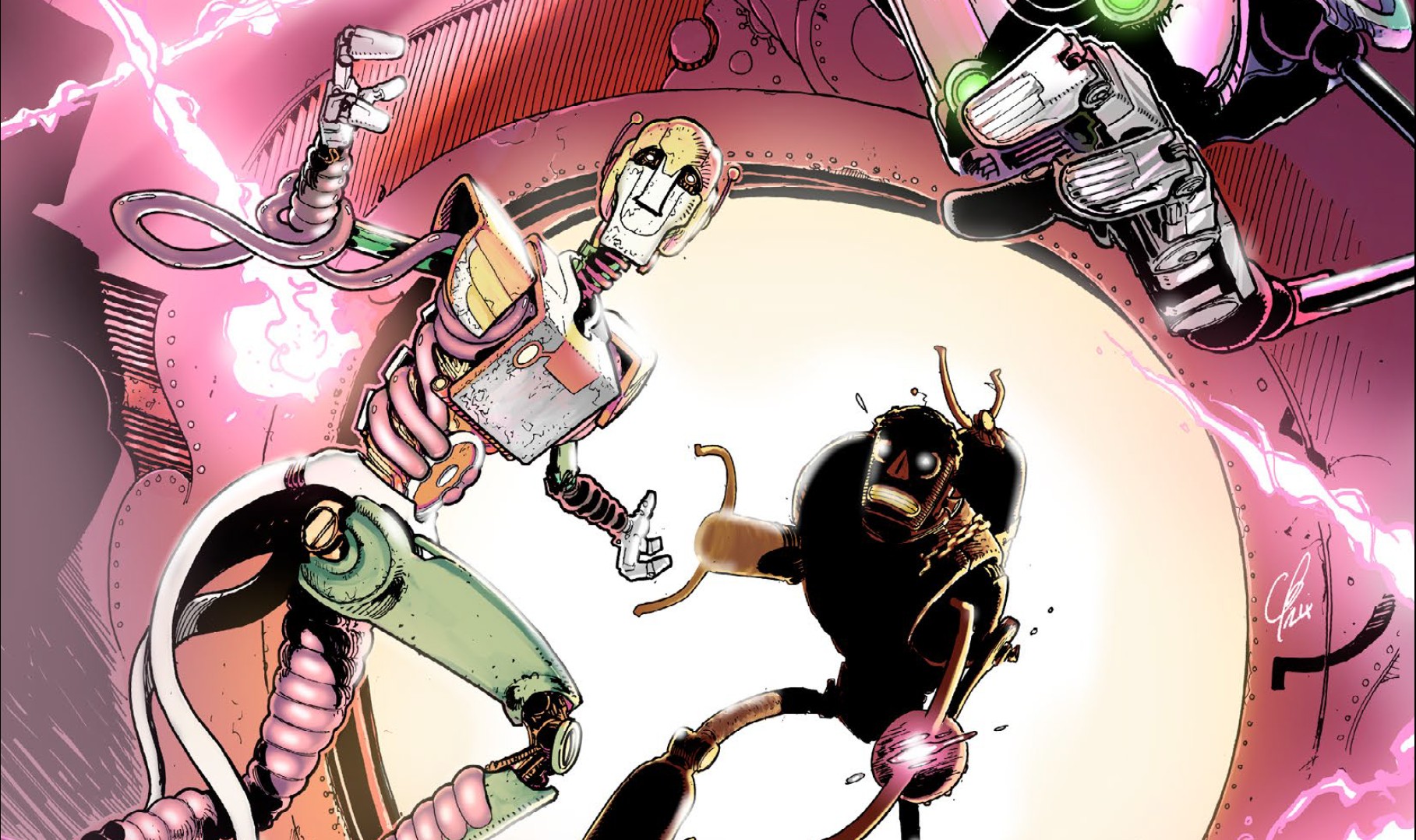

If you worry about what happens in the universe after humanity dies out, the first issue of Cyberarchy lets us know that robotic life will go on, building a society of their own in our wake. Well, this particular vision of the future, created by Matt Hardy and Clark Bint, actually turns out to be a creatively-illustrated parable soaked in exaggerated dramatic irony. The opening issue releases on December third from Mad Cave Studios.

Courtesy of Mad Cave Studios
The first thing you’ll notice is the bewildering art by Clark Bint. He creates strangely constructed but lovingly drawn robotic beings with detailed parts. The robot’s expansive space ship is lush and varied. There is a lot to look at on every page, especially the many double-page spreads.
But just as much as the details, the untraditional perspectives and unfamiliar page layouts will leave you mesmerized. Panels are drawn from unusual angles – a whole room or corridor seen from above or from one corner of the room. The orientation is constantly changing – straight ahead, from above, sometimes rooms are drawn on their side, sometimes characters are upside down.
If that weren’t enough, the perspective is often warped, like a photograph shot through a fish-eye lens or an extremely wide-angle panoramic lens. Sometimes the foreground is greatly magnified compared to the rest. I can’t even image how hard it must be to drawn illustrations with these almost nonlinear perspectives.
Throughout the issue I could only marvel at how Bint meticulously constructed each page.

Courtesy of Mad Cave Studios
But while these images are all very impressive, they were at times too disorienting. I often had to stop at the beginning of a new page just to figure out what I was looking at. Sometimes I wasn’t sure at first how a page was supposed to be read. Once I figured it out, I was again awestruck by Bint’s craftsmanship. But it also took me out of the story every time.
As to the story, the premise is quite intriguing. Thousands of years in the future – and yet far in the past of the current robotic society – the sentient robots that had made life on Earth a utopia collectively stopped doing anything. As a result, humanity died out fairly quickly, becoming too dependent on the robots’ services. (Why the robots collectively decided to stop helping humanity is, luckily, left a tantalizing mystery.) The robots then built a culture and society of their own, including “giving birth” to newly-created robotic entities.
This issue actually opens with the “birth” of Ash, a cute robot that looks a little like a floating trash can with awkward arms, wearing a bowler hat. Ash is welcomed into existence by his creator/father, Rust. The rest of the issue follows Rust as he gives Ash an educational tour of the robotic society on the giant, stranded starliner they call home. It’s not really much of a narrative, but rather an effective world-building set-up for the rest of the miniseries – introducing everything the reader needs to know.

Courtesy of Mad Cave Studios
And we quickly realize that this robotic society – especially its obvious flaws – is really a strongly exaggerated metaphor for our own, modern-day world. Writer Matt Hardy lays the dramatic irony on thick, turning Cyberarchy into a sort of parable, emphasizing the problems of today by viewing them through the lens of the wildly embellished robotic world.
It works well. I love the dramatic irony. And Hardy makes some very good points about the foolish ways we approach societal problems. The final twist drives these points home like a hammer blow.
All in all, Cyberarchy by Matt Hardy and Clark Bint is dominated by exaggerations and extremes, where everything good about the comic comes with a slight downside. Bint utilizes extreme perspectives and nontraditional page layouts to create mesmerizing images you won’t soon forget. Unfortunately, the images are at times too disorienting – taking me out of the story as I tried to figure out what I was looking at. Hardy’s use of overly exaggerated dramatic irony while introducing the robotic society serves as an eye-opening metaphor for the flaws in our current world, even if the “tour of the ship” plot is a little lacking on drama itself. Still, I’m interested to see where Hardy and Bint take this post-human robotic society in the next issue of Cyberarchy.




You must be logged in to post a comment.