

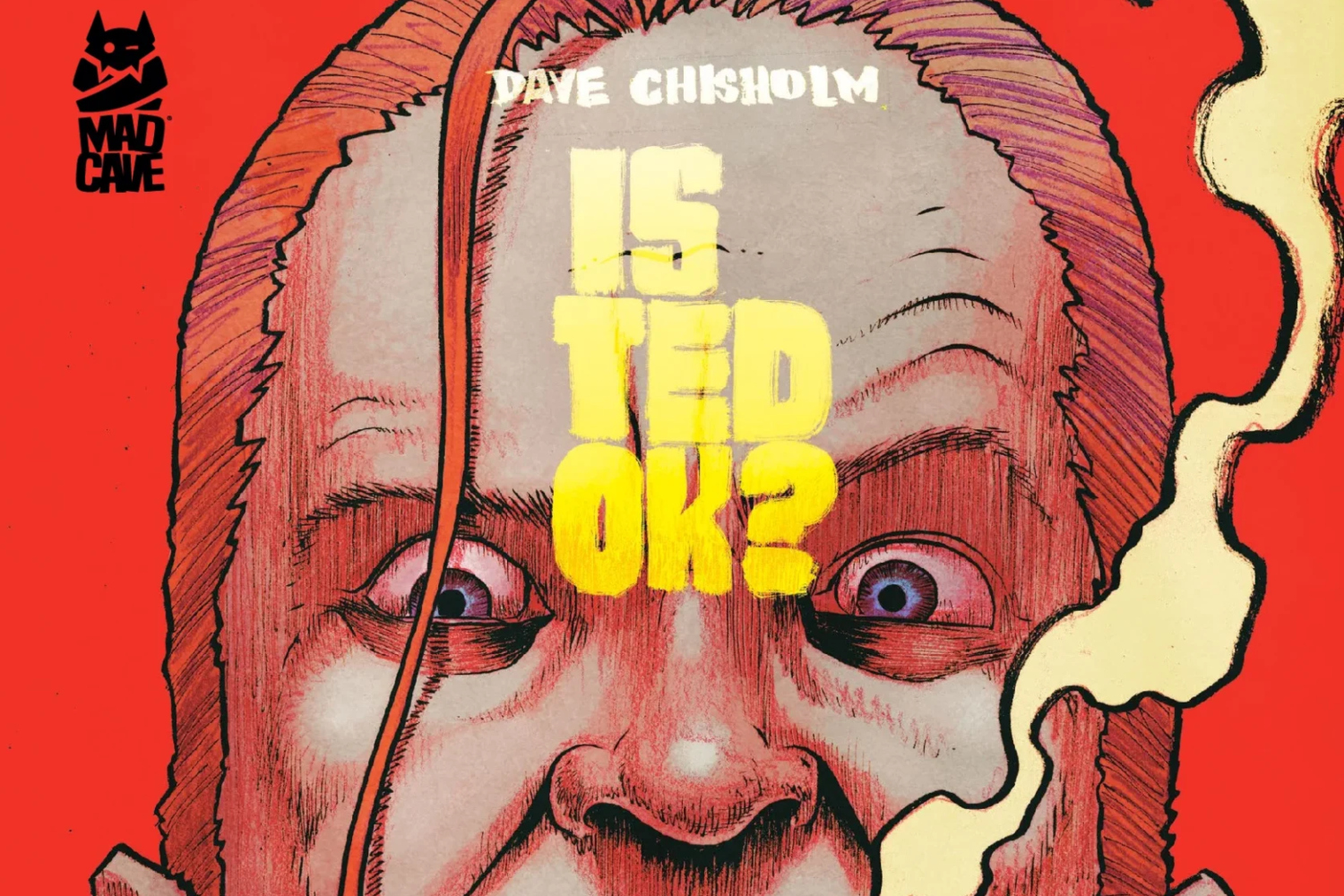

I’ve talked a lot about the value of second issues, but Dave Chisholm seems to have fully banked on his own third issue.
At least that’s the vibe I got when we spoke earlier this year ahead of Is Ted OK? That for as much power and heft that exist in issues #1 and #2 (and, trust me, those had nuclear levels of both), issue #3 would be where his master plan really started to unfold in a major way. That this issue would be a proper turning point in Ted‘s saga, and it would make us question everything we knew and even our very relationship to the book at large.
And Chisholm was right: Is Ted OK? #3 is a massive leap forward for an already vital and potent book.
That “shift” comes not with anything particularly revolutionary or transformative. (Again, even as the book is hugely novel.) Rather, it’s that Chisholm has simply turned up the heat on what’s already worked across issue #1 and #2, taking us from a kind of slow and steady introduction (well, slow enough in comparison, at least) right into the upper stratosphere. The formula’s been in front of us this whole time, but now it seems more undeniable than ever.
So, for instance, if you worried that Ted and Sarah’s relationship might change, it certainly has — in the very best way. As the duo got to know one another in the first two issues, it all felt a little one-sided. (Which sort of made sense as Sarah was spying on Ted for their shared employer.) But in Ted #3, that connection feels more lively and potent than ever before.
A scene near the issue’s end sees Sarah open up for the first time, and she really moves from a kind of isolated narrator role into someone who is very much in the thick of it with Ted. And to see Sarah emerge even more approachable and “grounded” does a lot to inform and extend our relationship with her moving forward. She is, like us, now a player in this existential saga, and I’m interested to see what we learn of her going forward. And that resulting knowledge will inevitably alter her relationship with Ted and the book itself.

Courtesy of Mad Cave Studios.
At the same time, without revealing too much, Ted inevitably learns of Sarah’s background and her corporate role, and that might will likely complicate their dynamic going forward. But I mean complicate in a decidedly good way, as the pair are engaging in this really organic, extra meaningful manner that brings them together to solve the mystery of Ayn-Styne. I quite like that there’s a little uncertainty or “messiness” to their relationship; it makes them feel like they’re actually a couple of pals on an adventure (and not just something theoretical).
Similarly, their newly-textured bond makes some of their conversations come off more significant and nuanced. Before it felt like we were discussing things (important stuff, mind you) in some mostly hypothetical sense. But now their talk about a person’s nature (and inclination toward violence, what it means to be truly available/open, and even living with anxiety) are grounded in a really poignant way. It’s a relationship that eases us effortlessly into Ted‘s profound philosophical ideas, and makes easy breezy the work of fully exploring this story.
Still, this book continues to be so much more than about Ted and Sarah. Brody (a character who has been around since Ted #1) finally starts to feel real. In fact, his “relationship” with Sarah (one based on imbalanced power dynamics) is such a wonderfully perfect counter to Ted-Sarah. His role remains unclear (maybe it’s HR, although I’d reckon that uncertainty is a feature not a bug), and he emerges from Ted #3 as this great foil for the pair and a further grounded realization of this book’s interest in fate, personal violence, etc. Even the way Brody looks (like some dumb alpha bro in a cheap, gaudy suit) feels like its own commentary that only adds to his relevance in the story (without overshadowing anyone/anything).
View this post on Instagram
Meanwhile, Noah (TM) finally appears not just in the book’s “B story” but in the “main” narrative as Ayn-Styne holds a mandatory employee conference/party. For one, this touches on this “inversion” Chisholm had mentioned in our interview, and how the A and B stories might eventually “swap.” That certainly felt like the case (or, at the very least, a certain coalescence occurred), and while Noah (TM) is playing a much bigger role, Ted and Sarah’s part never feels any less meaty/substantial.
That’s probably because Noah (TM)’s big announcement is definitely a bigger/more significant pivot for the book, but it once again comes to support the existing narrative. It’s not Noah (TM) getting all the spotlight, but rather Chisholm positioning the big cheese in such a way that the world’s first trillionaire can push the story forward and, sort of like with Brody, serve as a counter to the increasingly bonkers happenings with Ted/Sarah. Even as he’s stepped up, though, Noah (TM) remains mysterious enough, and he adds so much intrigue to the book even as it opens up more and more.

Courtesy of Mad Cave Studios.
And speaking of increasingly bonkers happenings, the conspiracy at the heart of Ted is also ever more gargantuan and brain-melting in its scope. As Ted discovered in issue #2, his company might be housing aliens. (Again, though, Chisholm is such a masterful storyteller that he fosters the right amount of doubt to get us thinking, which is just another thematic tent-pole of this entire series.)
In Ted #3, our heroes gather more clues that turn their frame of being and understanding around a full 180 degrees and add to the mystery and conspiracies that power this very story. It’s a turn toward more “familiar” stories with aliens/magic/superpowers, but done in a way that never removes Ted from the singular context its crafted for itself in just three issues. Because Ted is familiar enough, but it moves and operates with a emotionality, curiosity, and ambition that makes it thrillingly unpredictable.
Ultimately, this marked uptick in the weird and paranormal (and that’s already saying a lot for Ted) is done with more of the deliberate and organic might that Chisholm has maintained thus far. It aligns storylines — Noah (TM)’s big announcement, further happenings at The Dome, Ted’s whole deal/backstory, etc. — in a way that we can better see the scope of this world even as we’re still left to grapple with the path forward and larger meaning.
Part of me thinks it’s a kind of prize being offered; you’ve made it through the important, foundation-building of Ted, and now you can see how deep this rabbit hole really goes. And it’s pretty deep from what I can tell, and Chisholm is making good on his promise in a hugely pleasing manner.

Courtesy of Mad Cave Studios.
And more than things feeling bonkers in the best way, I think that commitment and resolve is what really matters the most. It’s Chisholm exuding this deep, undeniable humanity because that’s what Ted is really all about: people. Sure, people who are in some rather intense (albeit semi-relatable, tail-end-of-Capitialism-level familiarity), but people nonetheless. Folks who are trying to sort out themselves, decipher their place in the world, and manage this increasing notion that they’re not in control.
And that no matter where this story goes, Ted will exude those energies above all else, acting as a friend (the book is Sarah and we’re Ted, I think) as we work through ideas of our increasing detachment amid technological evolution; what really makes us human; and how we find connection in a world that punishes such things. This book could pivot a million more times, and as long as that human spark remains, you can follow Ted through some very big, very scare terrain.

Courtesy of Mad Cave Studios.
And if all of that narrative might and general storytelling artillery weren’t enough, Ted #3 is also perhaps one of my favorites visually/artistically. Sure, that’s also saying a lot given the feats accomplished in issues #1 and #2, and how Chisholm has crafted a singular visual identity (that is, once again, like 2000 AD meets the video for “Paranoid Android”). But Ted #3 has one of my favorite openings (the first piece of preview art in this review), and that nightmare scenario shows how Chisholm’s technical prowess only adds to our enthusiastic immersion. Be it the composition, the color choices, or just the intense emotions, moments like this one grab you in a way to almost force your immersion in a complicated book.
There’s also great mixed media stuff that appears in Sarah’s childhood story to Ted/Brody (making this moment resonate with terrifying effectiveness); some awe-inspiring scale with elevators (constantly playing with the scope of this world is a great way to engage and disarm us); and even just some of my favorite instances of Ted and Sarah connecting and emoting deeply with one another. There was so much in this issue, and on so many levels (the personal, the otherworldly, etc.), and all of it maintained a vital cohesiveness.

Courtesy of Mad Cave Studios.
Those instances (and there’s so much more still across this issue) are oddly the icing on the cake that is Ted. In some other books, one of those scenes alone might have been enough to spike your interest and define the issue’s overall value/significance. But with Ted, it’s oddly a small drop in the pond (sans any unintended disrespect, of course).
That’s because Ted is a book that’s deeply alive, and it’s been working to excite, unnerve, and connect with readers from page one. After issue #3, that power is all the more apparent and undeniable, and whatever happens next, this book has its claws in my brain and it won’t let go until we’ve felt and seen the true scope of its storytelling might.
Your move, Is Ted OK? #4.




You must be logged in to post a comment.