

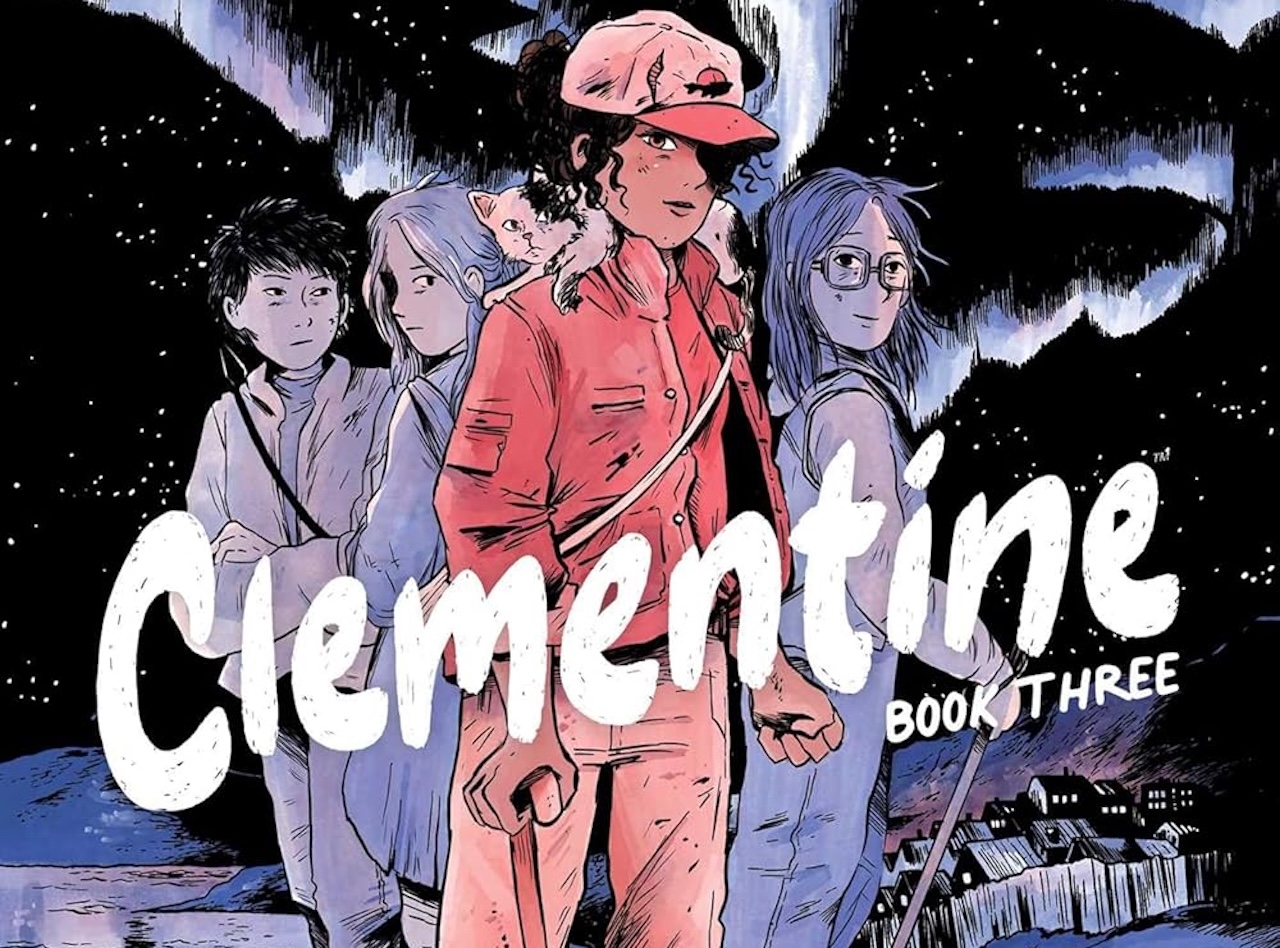

The world of The Walking Dead is just as much about power-mad, despotic rulers as it is the titular walking dead: it’s a property that prides itself on allegorical examinations of power politics, of human nature’s most violent streaks, and of the human capacity for crossing lines.
Most of these miniature power dramas take place in humanity’s fractured survivor camps: precarious survival enclaves in which communities large or small eke out tragic and fragile existences. There is invariably an abusive leader, but there is also a very tenuous system of keeping the dead at bay.
Tillie Walden’s brilliant Clementine series has featured its fair share of weakening borders and frail community; it’s a series much more concerned with the tender boundaries between individuals than it is the connections between larger communities. While Clem has found herself in frozen ski-lodge hells and cliffside fishing villages, the large bulk of the human drama plays out in the reawakening of Clem’s ability to discover and appreciate love and intimacy. After the ceaseless barrage of loss the character experienced in The Walking Dead series of games from Telltale, Clementine began this series of books as a stoic, emotionally walled character. She could not bear to form connections with people she knew she would lose violently.

Image
Over the course of the first two books of the series, Clem slowly finds herself part of a new family, even after the survivalist camps collapse around her. As each small community’s fragile walls fall to the dead and safety is ripped from them, Clem and her friends see their personal emotional boundaries falter. Clem falls in love, as do a pair of her peers. In a world of violence, only heartbreak can follow.

Image
The final book of the series subverts the general trends of the franchise: while there is loss, it is of a much more mundane variety. When a power-mad despot presents themselves, they are quietly shut down. The dead break down no walls; the larger community is left unmarred. Clem is the only one left devastated.

Image
That’s because Clementine has always been about the growing emotional resilience of its main character. As she has learned to love and trust again, Clem has also been learning to cope with anticipatory loss. In this third book, she is forced to learn to grieve appropriately, to eschew the violence of her world in order to face the very real tragedies of the human experience.
Though the whole series has been quiet – there is a tender, tonal hush even in the most gruesome moments – Book Three might be the most subdued. Its heart-wrenching moment arrives without violence, as the most tragic moments of most lives do: it is a medical anomaly, not a zombie horde, that upsets Clementine’s fragile world. The expected civil unrest does not lead to annihilation. This is a portion of The Walking Dead where society is not wiped from the face of the earth.

Image
This novel turn from the franchise hallmarks makes Book Three all the more profound. Clementine’s growth comes as a revelation, not forged in fire but forged in acceptance. It’s a tragic story, yes, but it’s a tragedy the series has been barreling toward all along and, once it arrives, both Clem and the reader find that they can face it.
Clementine: Book Three deals in the anticlimax of the everyday, and though it might not be the rip-roaring experience some fans hope for, it is exactly as it needs to be. What little resolution a story like Clementine’s can find is found here, quietly. The standard conventions of its larger franchise are ably and smartly eschewed, and what we’re left with is a meditation on human growth.




You must be logged in to post a comment.