

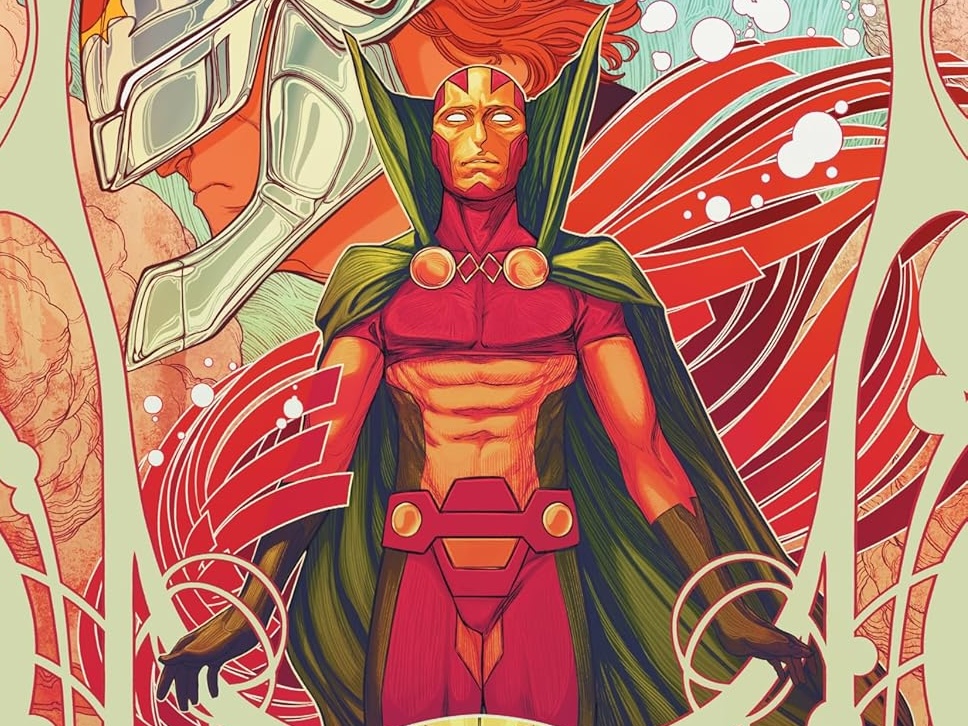

In New Gods #2, readers begin to get a better understanding of how Ram V and Evan Cagle will synthesize their version of these characters. How will their new creations fit into the world Kirby created, and will it feel like it works? What do their efforts to balance the various tones of the New Gods look like? And, can they handle Apokolips as well as they’ve handled New Genesis in issue #1?
V and Cagle begin by introducing Karok, the imminent threat who was teased in the series’ first issue. This first scene is reminiscent of Feyd-Rautha’s introduction in Dune Pt. 2, specifically in the way in which it introduces a darker, more violent world to contrast the previously established setting of the book. It’s clearly crafted to feel different than the New Gods themselves and it largely works.
Karok is humble where the gods are arrogant. He scavenged whereas they were provided for (which is an interesting contrast to set up prior to introducing Forager and the bugs in this story). He’s not special in a narrative which is full of the presumed special.

DC
This intentional distinction is coupled with what might be a bit of an unintentional one, which is that Karok’s design reads a touch generic amongst everything else in the book. There is a griminess to him which matches his characterization of coming from the underbelly of godhood, yet there’s an attempt at realism and lack of whimsy which doesn’t quite seem to match the rest of the book. Even the ships he travels on seem as if they could’ve flown straight out of another book.
Cagle’s hand at design is on display throughout this issue, both in deploying new designs and in choosing which historic designs to evoke for the story he and V are telling. On Apokolips he reimagines Mantic grotesquely, but chooses to air incredibly close to the classic design for Kanto (bypassing Jason Fabok’s modern redesign of the character from 2015’s Darkseid War). This creates a sense of contrast, which is present throughout the book, of an empowered underbelly and an out-of-touch elite.
In this issue V and Cagle deliver clarity for what this world holistically looks like in their hands. With each character V is attempting to deliver readers a sense of how humanity faces a perceived inevitable end. It’s in the fear Highfather feels. It’s in the hope Mr. Miracle and Big Barda feel. It’s in the pleasantries exchanged by Metron and Desaad. Just as V has intended, the gods of this book are marked by their humanness more than anything else.
This is emphasized by the quiet addition of a new character, Akala. Though they’ve yet to feature in much excitement in the book, the choice to introduce a large, masculine character who serves thus far as Highfather’s emotional support indicates the vulnerability and communal needs of these gods to the readers.
On Apokolips things aren’t much different. In the absence of Darkseid, the pettiness of petty characters takes center stage as a struggle for power develops. This is not something which readers will be surprised to read, but it underscores the same vulnerability which was previously mentioned.
The ubiquity of this approach by V and Cagle, even imbuing the gods of Apokolips with a relatable humanity is reflected in this issue’s excerpt of the Prometheus Codex. The conflict which they’re laying the groundwork for isn’t simply one of good vs. evil but one which is against “uncreation, the absence of life.” Its antagonist will exist “not in opposition to life, but in opposition to existence.”
This is really strong framing of the conflict by V for multiple reasons. First, it absolves the book’s cast from the need to operate in relation to a moral binary, which has been the reality for the characters from the beginning. This supports the second reason, which is that it allows the book and characters to engage with a unique new conflict which will hopefully force them into new and interesting relationships and situations. Lastly, it creates the opportunity to reimagine the focus of the conflict.
Throughout its existence, the conflict of the New Gods’ books have been embodied in a few specific characters: Orion and Mister Miracle, High Father and Darkseid. This new conflict is able to find embodiment in new characters, whether it’s the original characters introduced here or Kirby classics. If V desired to embody this story in a woman or a non-white character, there’s an opportunity to make that a reality for the first time ever with these characters.
More than anything, V and Cagle have given readers clarity for what their New Gods will be in this issue. So far, the book is more engaging, suspenseful and surprising because of this choice to imbue the gods with a deep level of humanity. It’s a choice that feels like it couldn’t be achieved without the emotive and moving work Cagle displays in the book’s quietest moments. The tenderness with which Akala holds Highfather. The reassured confidence Mr. Miracle finds in Big Barda. The fear in the face of Desaad.




You must be logged in to post a comment.