

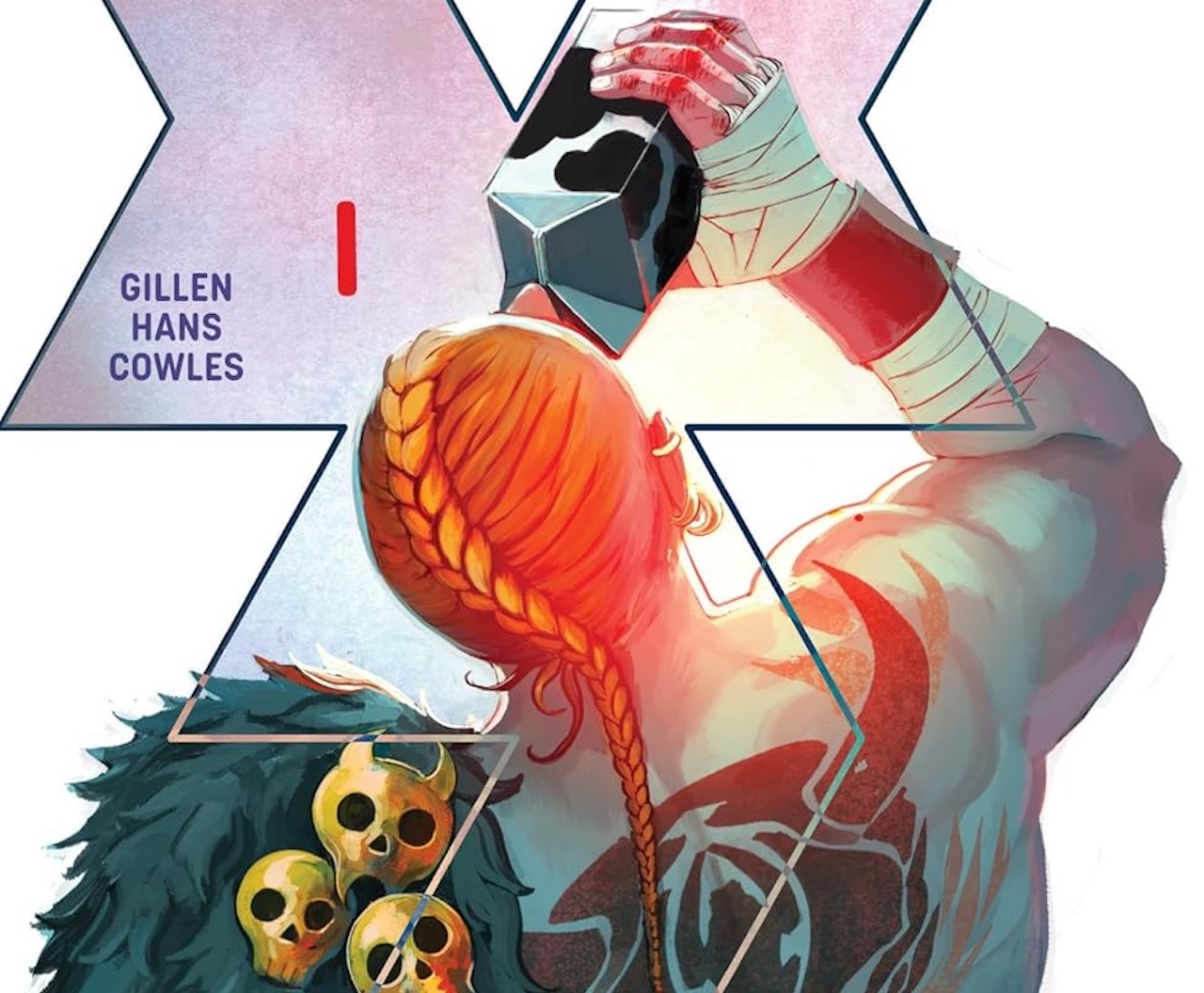

Four issues in, and Stephanie Hans and Kieron Gillen’s DIE: Loaded has consistently worked to craft a tale that twists and subverts the shape of the original DIE. Loaded‘s visual language for its unfortunate party and their powers run in opposite directions from the first series’ cast (Loaded‘s Dictator Margaret wields her horrifying powers ike a bomb, where DIE‘s Dictator Ash let their horrifying powers flow like water). Narratively, Loaded‘s cast are facing a world they know at best a sketch of, while DIE‘s cast knew the game all too well. That has been the pattern so far, so it’s fitting that an issue that openly investigates genre and narrative conventions pointedly breaks the pattern with Loaded‘s most direct case of visual and narrative continuity so far.
As with issues two and three, DIE: Loaded‘s fourth issue introduces a new party member to overall protagonist Sophie’s unlikely crew. DIE-the-world called six players to its great game. In order for the game to end, these players must unanimously decided that the game is over. If Sophie wants to get home to Ash and their son Stuart, she needs to get everybody in one place and on task. Thus far, she’s put got a trio. She is the Godbinder, bartering with deities and dealing with the cost. Molly is the Rage Knight, literally turning their anger into power. Margaret is the Dictator, whose word becomes law. Issue #4 introduces the Fool, who Sophie needs to find amidst a flock of fools, a gaggle of would-be conquerors and champions who are all certain that they are the Chosen One and that the world exists for their pleasure.

Image
Per the DIE RPG manual, “The Fool’s the swashbuckler, a romantic rogue, the life and soul of the adventuring party. The rest think they’re irresponsible, but the Fool’s abilities mean the only responsible thing to do is be irresponsible, so screw everyone else if they can’t take a joke. Fools rush in…and their friends have to deal with the consequences.”
Thus far, Loaded‘s party have wielded powers that are visually fantastic, vessels for Hans’ skill with crafting dramatic, larger-than-life imagery. The new Fool has a fun design, but he’s not exploding people’s heads with a word or treating with gods to do his bidding. He barrels through chaos with a careless grin, reveling in being able to run wild. Hans’ expression work is superb, especially when she contrasts the Fool with Sophie, Molly, and Margaret, none of whom have much time for his antics.
In terms of narrative, the Fool makes for an interesting contrast to the current party, all of whom appear to be significantly more in touch with their angst than he is. Uncharitably, he’s an obnoxious ass who has the good luck to be “playing” a class that runs on a knuckle-headed refusal to take anything or anyone seriously and allows him to indulge every one of his power fantasies. Unlike Sophie, Molly, and Margaret, all of whom have personalities and drives that heavily contrast the folks who previously held their roles, Loaded‘s Fool’s persona puts him in direct continuity with DIE‘s Fool, Chuck. There are significant differences between the two, but one issue into the new Fool’s run they’re comparatively subtle next to the sharp distinctions between the rest of the party and their predecessors.
Consider this: hidden information is a major mechanic in games of all kinds, particularly role playing games. The dissonance between the role Chuck was playing/had to play and the truth of him led to one of DIE‘s most moving moments. I’m very curious to see what the new Fool will reveal of himself and how that will click and clash with his Fooldom.
Metatextually, issue DIE: Loaded‘s fourth issue uses the new Fool’s living out a power fantasy (not to be confused with living in the Gillen-penned comic The Power Fantasy) to dig into the nature of those fantasies – the potential for indulgence, for abuse, for transformation or stagnation. Per Gillen in the issue’s closing essay, most of the issue is “broadly comic,” but there is a queasy underpinning to it, or, in Gillen’s words, “a lingering horrorshow if you think about it.” One of the key questions is context. While none of Loaded‘s party are as intimately tied to DIE-the-world as the first party, everyone but the Fool has demonstrated at least some understanding of the fact that DIE-the-world did substantial damage to their loved ones. So far, he’s been on a tear. Now that he’s joined up with the party, he’s going to get that context, whether he wants it or not.

Image
Artistically, issue #4’s goofier tone also provides Hans and Gillen a chance to get silly. Hans presents an array of false chosen ones who run the gamut from would-be samurai to a chessman (not of Mars) who demands to be taken seriously to even zanier folks. One of Sophie’s divine invocations leads to a prime cut bit of bathos, thanks to the dissonance between the grandeur of a god and the mundanity of the question they’re shouting to the world. The issue consistently recalls The Ludocrats‘ gleeful nonsense. There aren’t any trials by wombat in DIE: Loaded, but it gets close.
As a comic, DIE: Loaded remains a pleasure. As a work in conversation with its predecessor, and the genres in which it is moving, it’s thoughtful and thrilling. This is a terrific comic.




You must be logged in to post a comment.